.svg)


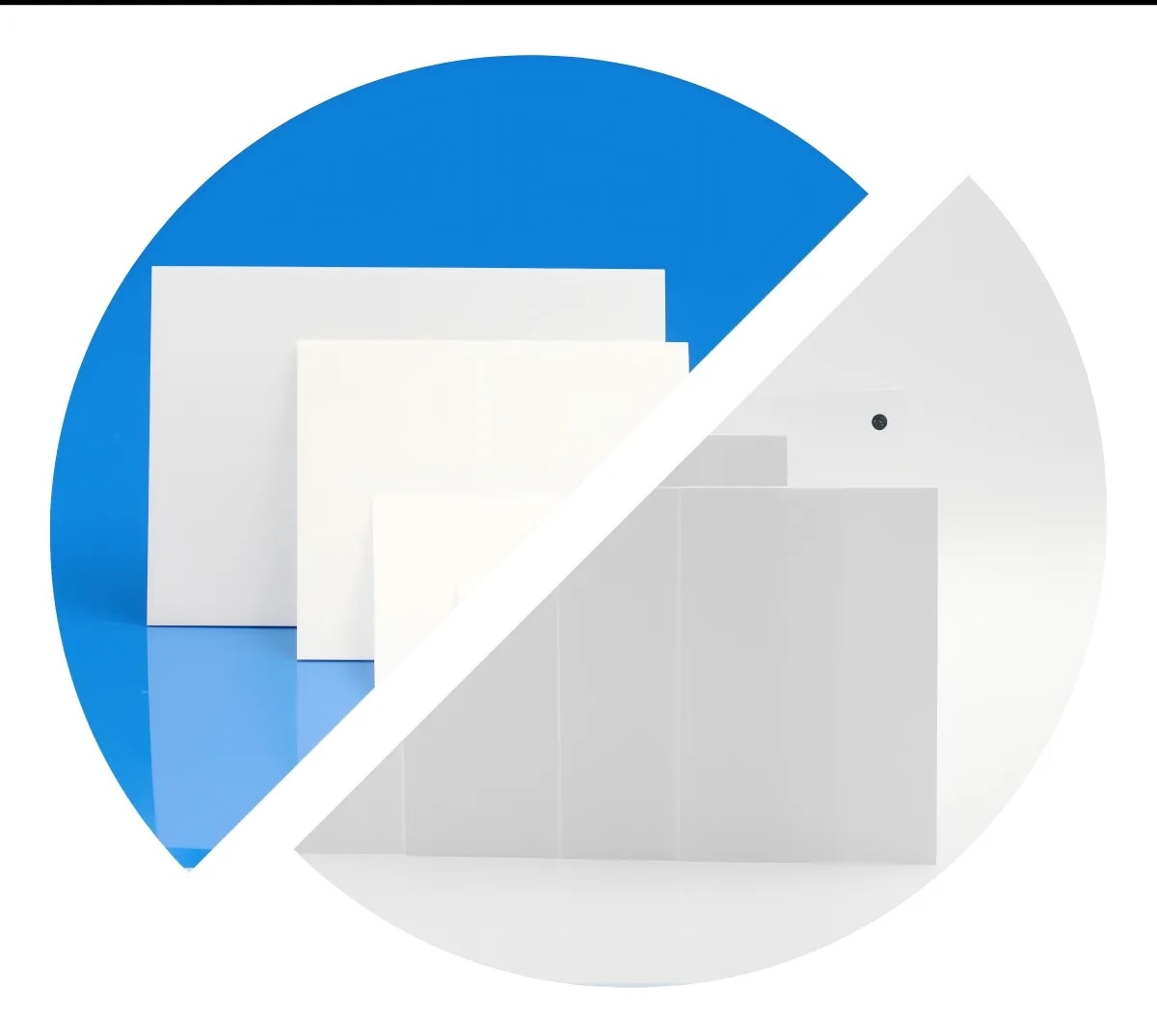
Aluminium oxide ceramic substrates are extensively employed as base materials within the radio frequency and microwave electronics sector. Their high dielectric constant facilitates circuit miniaturisation, while their excellent thermal stability, high substrate strength and superior chemical stability outperform most other oxide materials. These substrates are suitable for diverse applications including thick-film circuits, thin-film circuits, hybrid circuits, and microwave component modules.
Alumina ceramic substrates are classified by purity, commonly 90%, 96%, and 99%. The primary difference lies in the amount of dopant material. Less dopant results in higher purity. Alumina substrates with different purities exhibit distinct electrical and mechanical properties. Generally, higher purity substrates have a higher dielectric constant, lower dielectric loss, and better surface finish.
Applications of Alumina Ceramic Substrates in Circuits
① Thin-Film Microstrip Circuits
Using alumina ceramic substrates for thin-film microstrip circuits allows for gold layer thicknesses up to 3.5µm. These circuits can connect to external circuitry via gold wire bonding. Common substrate thicknesses include 0.127mm, 0.254mm, 0.381mm, and 0.508mm.
② Thin-Film Filters
Thin-film filters fabricated on alumina ceramic substrates are commonly used as frequency-selective elements in various microwave modules, assemblies, and systems. These filters are manufactured using thin-film processing techniques including sputtering, photolithography, wet or dry etching, cleaning, and dicing.
③ Thin-Film Terminations
Thin-film terminations designed on alumina ceramic substrates are frequently used for port matching in microwave circuit modules and assemblies, absorbing excess reflected power. The sheet resistance of the tantalum nitride (TaN) layer in thin-film processes is controllable, allowing for the production of high-precision terminations. Their extremely small size makes them excellent choices for module miniaturization. They are typically attached to circuit terminals using conductive epoxy or gold-tin (AuSn) eutectic bonding.
④ Thin-Film Equalizers
Thin-film equalizers on alumina ceramic substrates are commonly used to adjust broadband power flatness in microwave circuits. By varying the sheet resistance of the integrated TaN layer and the resistor pattern design, different resistance values are achieved to shape the device’s output waveform, compensating the input power signal to achieve the desired power flatness.
⑤ Thin-Film Power Dividers
Thin-film power dividers on alumina ceramic substrates are often used in multi-channel communication network systems. They inherently provide power division according to a specified ratio, typically featuring one input and multiple outputs. Thin-film power dividers readily facilitate multi-section ultra-wideband designs, resulting in physically small components that are easy to integrate and offer good performance.
⑥ Thin-Film Attenuators
Thin-film attenuators designed on alumina ceramic substrates are commonly used for attenuating large signals in microwave RF modules or for providing multi-step attenuation adjustment in digitally controlled attenuator circuits. They can achieve high attenuation flatness over ultra-wide bandwidths with stable performance.
⑦ Thin-Film Couplers
Thin-film couplers on alumina ceramic substrates are often used for power detection or signal separation in microwave module systems. Couplers with arbitrarily weak coupling factors can be designed. Integrated isolation loads can be implemented using TaN. Ports can be designed in surface-mount configurations, allowing direct soldering onto the circuit board. Multi-section designs enable operation over wide bandwidths.
⑧ Thin-Film Hybrid Couplers (Bridges)
Thin-film hybrid couplers, also known as 3dB couplers or bridges, designed on alumina ceramic substrates, are commonly used to split signals with a 90° or 180° phase difference. The Lange coupler is a frequently used type, employing gold wire bonds for interconnections between transmission lines.
⑨ Thin-Film Resistors
Thin-film resistors fabricated on alumina ceramic substrates are often used in circuits requiring high precision, low noise, and high stability. They can be integrated monolithically during the microstrip circuit fabrication process or designed and manufactured separately as discrete resistors with various resistance values. They can also be arranged as resistor networks, allowing selection of the desired resistance value via gold wire bonding.
⑩ Thin-Film Capacitors
Thin-film capacitors designed on alumina ceramic substrates are often used in high-frequency filtering applications. Capacitors with arbitrary values can be designed for circuit use. Their performance is generally more stable than standard surface-mount chip capacitors, making them well-suited for high-frequency circuits.

Declaración: Este es un artículo original de INNOVACERA®. Por favor, indique el enlace de origen al reimprimir: https://www.innovacera.com/es/sin-categorizar/que-ventajas-ofrece-la-aplicacion-de-circuitos-sobre-sustratos-ceramicos-de-alumina.html.

 enquiry