Technical Specifications:
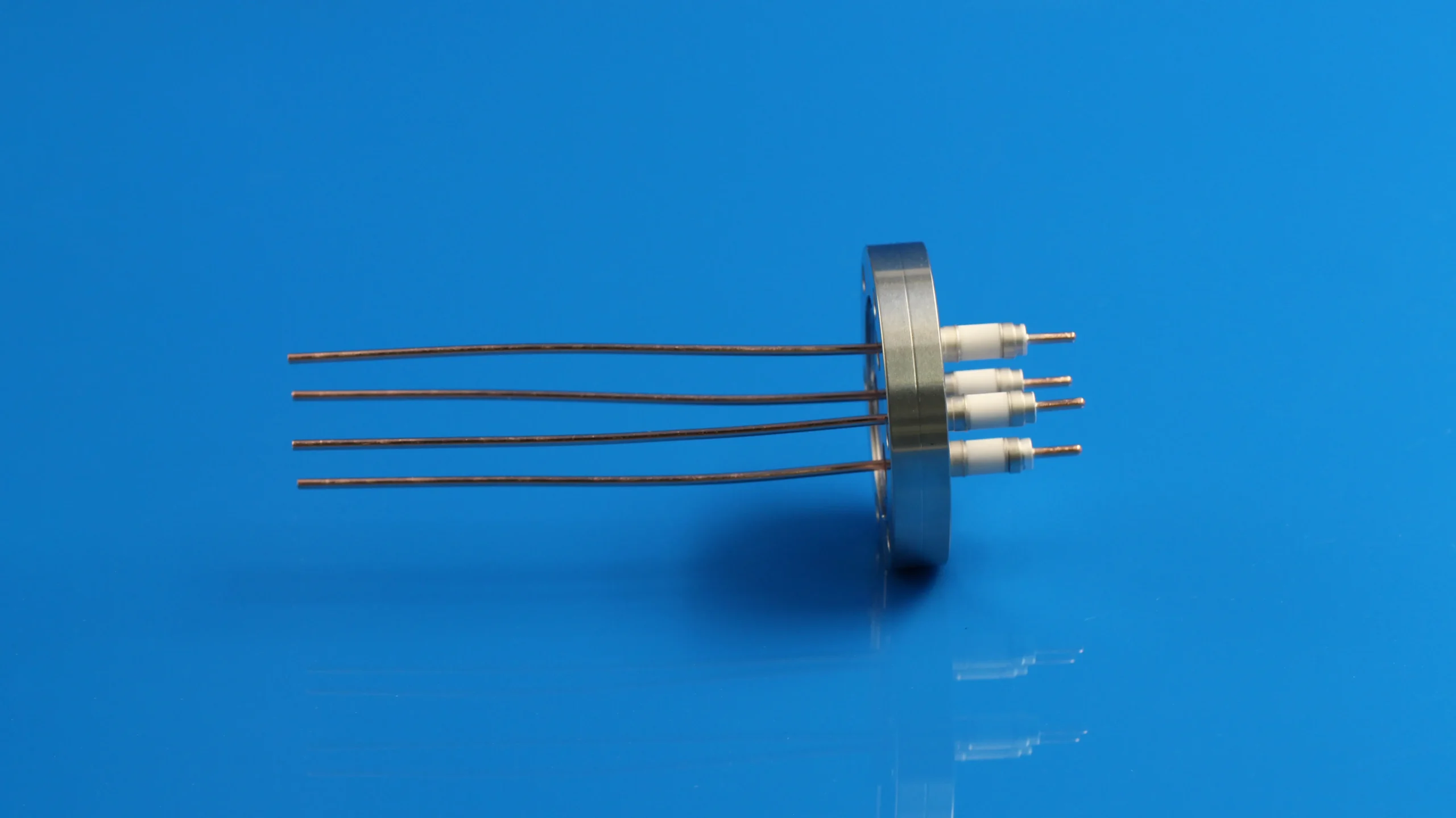
- Number of Pins: 4
- Voltage Rating: 10 kV
- Current Rating: 30 A
- Conductor Diameter Size: 0.094 inch , 2.3876 mm
- Conductor Material: Copper or Molybdenum or Customization
- Insulator: 95% Alumina Ceramic
- Flange: CF2.75 (CF35)
- Using Temperature: -269 to 450 °C
- Pressure Maximum: 1500 psig
- Size: OD69.5*169mm
Advantages:
- Up to 30A high current per conductor
- Stable performance under 10kV vacuum conditions
- Excellent conductivity (copper conductors)
- Reliable ceramic-to-metal sealing
- Ideal for power supply systems
Application:
- High power vacuum systems
- Industrial vacuum furnaces
- Power feedthrough integration
- Plasma power systems
Contact us for pricing, lead time, and customization options by email of sales@innovacera.com.
Declaration: This is an original article of INNOVACERA®. Please indicate the source link when reprinting: https://www.innovacera.com/product/4-pin-10kv-30a-cf35-high-current-vacuum-ceramic-feedthrough
Frequently Asked Questions
What are the conductor options for the 4 Pin 30A vacuum feedthrough? Can it be customized for specific high-power applications?
Innovacera provides versatile conductor materials for this CF35 feedthrough, including Oxygen-Free Copper for maximum conductivity, Molybdenum for high-temperature stability, or fully customized alloys based on client requirements. This 4-pin configuration is specifically optimized for power transmission in industrial vacuum furnaces and plasma systems, supporting up to 30 Amps per conductor with a reliable 10kV voltage rating.
What is the operating temperature range of this CF35 ceramic feedthrough? Does it maintain a vacuum seal under extreme pressure?
Designed for extreme vacuum environments, this high-current ceramic feedthrough operates across a wide temperature spectrum from -269°C to 450°C. Its robust 95% Alumina ceramic-to-metal sealing technology ensures stable performance under high pressure (up to 1500 psig), making it an ideal solution for Ultra-High Vacuum (UHV) systems that require both thermal resilience and structural integrity.