A bidet seat may deliver comfortable wash water on a warm day, yet fall short when the incoming water is cold. Before increasing heater wattage, check the flow rate, available current and temperature rise the module must deliver.
At Innovacera, we supply ceramic water heater elements for smart toilets and bidet seats. For appliance and instant-heating module manufacturers, we recommend starting with the operating conditions below, then confirming the heater specification in the assembled water path.
Start with the cold-water condition
The useful heating load depends on how much water passes through the module and how far its temperature must rise. The same sizing principle appears in the US Department of Energy’s tankless water-heater guidance: evaluate flow and temperature rise together. Its residential-system examples are not bidet performance specifications.
Pwater ≈ 69.7 × Q × (Tout − Tin)
Power is in watts; Q is in L/min; temperatures are in °C. This steady-state estimate uses water density of approximately 1 kg/L and specific heat of 4.18 kJ/(kg·K).
| Flow | Inlet → outlet* | Calculated heat delivered to water |
|---|---|---|
| 0.50 L/min | 25 → 40°C | 523 W |
| 0.50 L/min | 10 → 40°C | 1,046 W |
| 0.50 L/min | 5 → 40°C | 1,220 W |
| 0.70 L/min | 5 → 40°C | 1,708 W |
The last row works well as a design check. A 1,600 W heater simply cannot continuously supply 1,708 W to the water. That operating point demands lower flow, a smaller temperature rise, or a different power spec. Control software won’t fix a sustained energy shortfall.
Where tubular ceramic heater fits
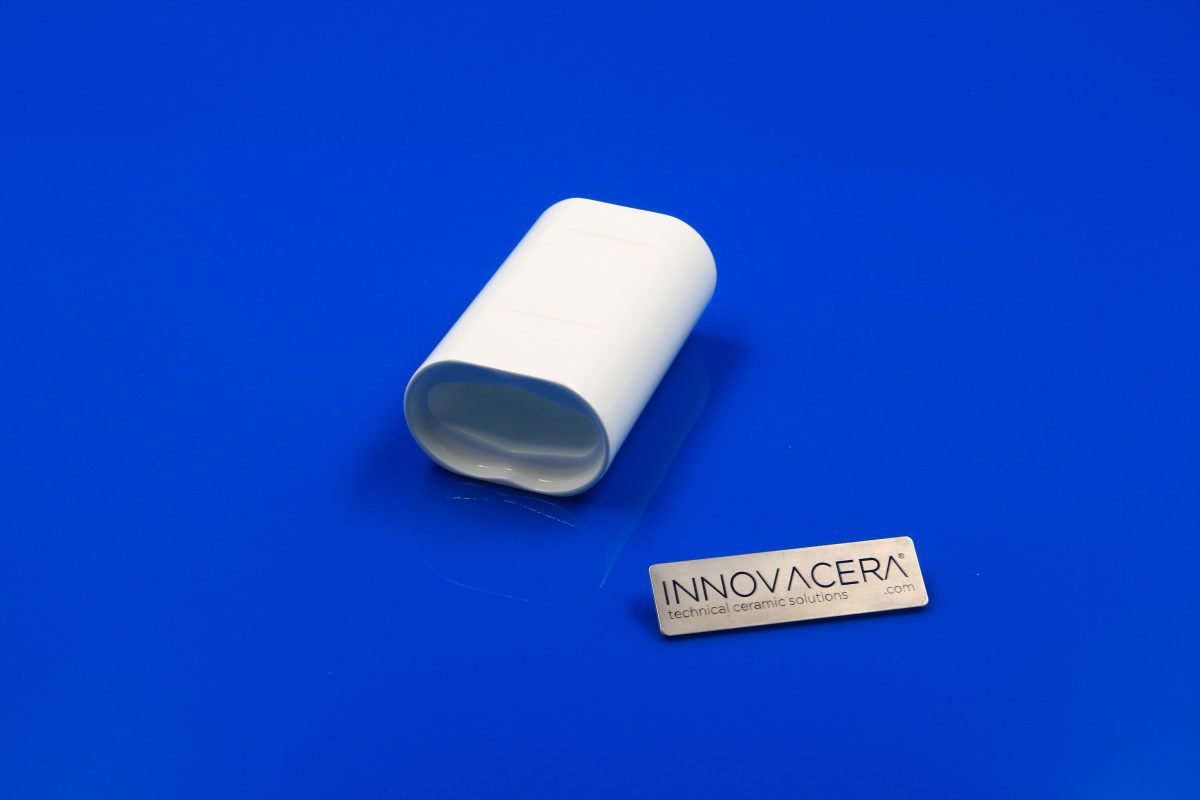
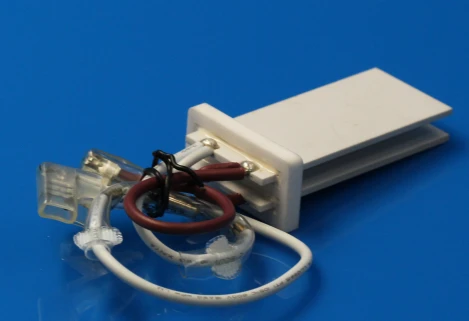
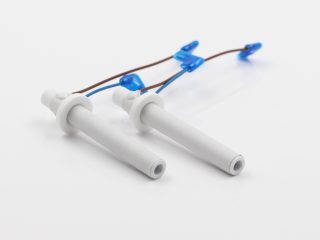
Innovacera tubular MCH element integrates a resistance circuit with an alumina ceramic tube for compact instant water-heating assemblies. Covering 110–120 V and 220–240 V systems, with power up to 1,600 W.
Alumina heaters are also described for bidet-water heating in Kyocera’s ceramic-heater application information, which mentions compact construction and rapid heating.
Temperature stability is a module-level result
Even a fast heater needs a well-matched sensor and control system. Water-path volume, sensor location, and changing flow affect what reaches the nozzle. We recommend measuring the delivered water temperature through startup, continuous operation and restart, rather than recording only a settled reading near the heater.
| Evaluation condition | What to record | Design question |
|---|---|---|
| Cold inlet, maximum specified flow | Inlet/outlet temperature, actual flow, voltage and input power | Can the module meet the required temperature rise? |
| Startup and flow changes | Temperature against time at the module outlet and nozzle | Is there a cold interval or temperature overshoot? |
| Stop and restart | Restart temperature and residual-heat response | Does retained heat affect the next wash cycle? |
| Reduced or interrupted flow | Detection, power interruption and recovery behavior | Do protection functions respond as intended? |
| Representative water quality and cycling | Deposits, temperature response, leakage and insulation results | is it remain acceptable after exposure? |
An MCH element should not be treated as a self-regulating PTC heater. The assembly needs appropriate temperature control and independent overtemperature protection.
IEC 60335-2-84:2019 covers toilet appliances and includes water heaters for spray seats within its scope. The applicable requirements and national adoption should be agreed with the appliance manufacturer’s certification team. Citing the standard does not mean that a heater or complete appliance is certified.
What to agree before ordering production parts
For purchasing teams, a sample that heats water is only the beginning. The drawing, acceptance criteria and test conditions need to describe the same part that will enter production.
| Item to agree | Information needed |
|---|---|
| Electrical configuration | Rated voltage, power or resistance, tolerance and resistance measurement temperature |
| Mechanical interface | Tube dimensions, seal locations, mounting constraints, terminals and drawing revision |
| Acceptance testing | Insulation/leakage test conditions, sampling plan and agreed pass/fail limits |
| Reliability evidence | Cycle timing, water conditions, sample quantity and measurements before/after testing |
| Supply planning | Forecast volume, qualification quantity, lead time and change-notification requirements |
Evaluate your instant water-heating projects with Innovacera
Send us your draft drawing with technology data such as supply voltage, inlet temperature, outlet temperature and expected demand quantities will help us review the heater configuration for sample evaluation.