technical ceramic solutions

News

Category Archives: News

Zirconia Ceramic Welding Pins

Zirconia ceramic welding pins work for resistance welding applications which are within the automotive and other spot welding assemblies within the metal fabrication sector. Zirconia resists to wielding sparks and spatter, since it’s with electrical insulation, none-magnetic and good surface finish.

Steel welding pins can be replaced by ceramic pins simply. You can only use thread, adapters or so to assemble ceramic pins to the machine.

General Size: M6, M8, M10, M12 and so on…

Zirconia Ceramic Welding Pins

Zirconia Ceramic Welding Pins


SIC China 2017 Will Take Place On June 7-9, 2017

Time :              June 7-9, 2017

Address:       Shanghai New International Expo Centre (SNIEC)

2345 Long Yang Road, Pudong Area, Shanghai, 201204, China

Organizer:  Shanghai Time & Space Expo Co., Ltd

Website:     http://www.sicchina.net/

Brief Introduce:

SIC China 2017 – The 9th Shanghai International Industrial Ceramics Expo, as one of the most important events in international industrial ceramics industry, will take place on 7-9 June 2017 at Shanghai New International Expo Centre (SNIEC), China.

With the rapid development of economy, industrial ceramics is widely used for mechanical equipment, gas appliances, communications, electronic devices, automobiles, motorcycles, textiles, environmental protection, water treatment, medical instruments, etc. The application scope of high-tech ceramics is extending, and the demand for new materials promotes the development of the industrial sectors, and further accelerates the development of industrial ceramics.

Exhibits Scope:

lndustrial Ceramics: fine ceramics, alumina ceramics, zirconia ceramics, high technical ceramics, electronic ceramics, functional ceramics, structural ceramics, abrasion resistant ceramics, carborundum ceramics, filter ceramics, high performance ceramics, ceramic fibre, ceramic seals, nano ceramics, honeycomb ceramics, oxide ceramics, nitride ceramics, porous ceramics, ceramic separation membrane, artificial crystal, fireproof materials, and biological and biochemical ceramics, oxide ceramic, non-oxide ceramic (carbide, nitrides, boride, silicides, etc.)

Electronic Components: functional sensor ceramic components of sorts, electrical ceramics, electric appliance ceramics, ceramic components of sorts, insulation device ceramics, capacitor ceramic, iron electrical ceramics, semiconductor ceramics, ion ceramics, insulation device ceramics etc.

Grinding Balls: ceramic ball, ceramic lining tile, plate, tower fillings and materials, new energy materials

Raw & Auxiliary Materials: natural and compound raw materials, oxide ceramic powder, non-oxide ceramic powder, raw material treatment techniques and equipment (crushing, grinding, mixing, weighing, palletizing and spray drying equipment), measuring equipment, etc.

Production Equipment: powder preparation equipment, product modeling equipment (dry granulation and semi-dry granulation modeling, isostatic pressing modeling, hot briquetting), reaction sintering, microwave sintering, etc.

Furnace & Apparatus Controlled Equipment: industrial furnace and apparatus controlled equipment (tunnel furnace, electric oven, atmosphere sintering furnace, microwave sintering furnace, small electric oven for lab purpose, new heating component, etc.) and other auxiliary equipment

Industrial ceramics-related new processes, techniques, materials, products and scientific research results.


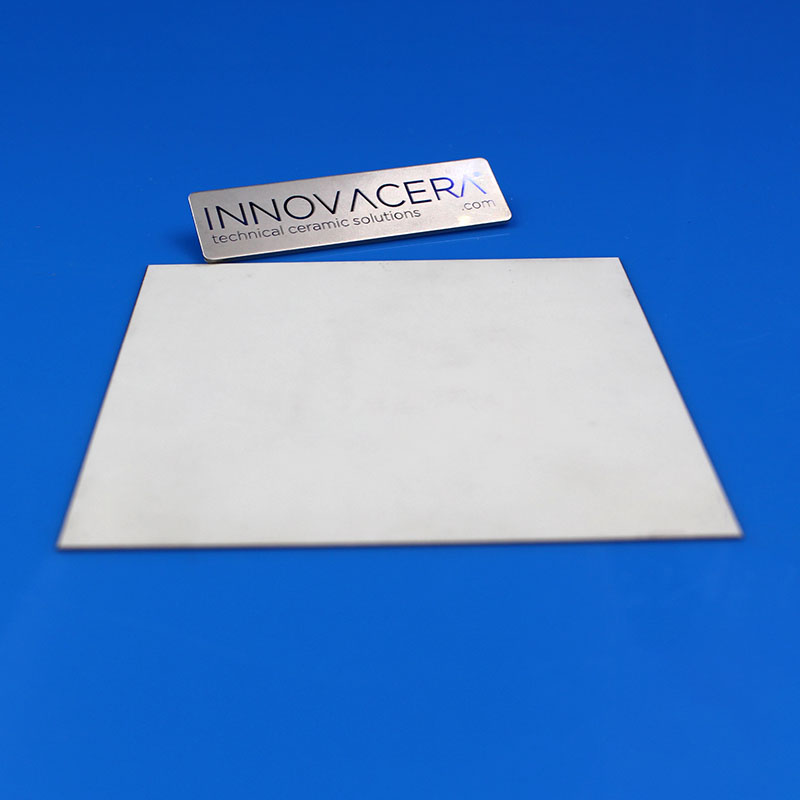
Direct Bond Copper/DBC Ceramic Substrate For Electronics

DBC Ceramic Substrate Specifications:

  • Material: 96% Alumina + Cu/Ag Coating.
  • Max Size: 138*188mm
  • Thickness: 0.25-1.0mm (0.25, 0.38, 0.5, 0.63, 0.76, 1.0mm).

General Size:

  • 2″*2″(50.8*50.8mm)
  • 3″*3″(76.2*76.2mm)
  • 4″*4″(101.6*101.6mm)
  • 4.5″*4.5″(114.3*114.3mm)
  • 5″*5″(127*127mm)
  • 5″*5.5″(127*139.7mm)
  • 5.4″*7.4″ (138*188mm)

DBC Ceramic Substrate For Electronics

Advantages:

  • Low thermal resistance.
  • Excellent insulation properties
  • Reduce solder layers, lower thermal resistance, reduce cavities, increase the rate of finished products.
  • Avoid withstand the stress caused by the impact of temperature changes, thus greatly extend the life of semiconductor products.
  • The new packaging and assembly methods can be realized with DBC substrates, it makes the products a higher degrees of integration and volume reduction.
  • The thermal expansion coefficient close to silicon in the semiconductor chip, it can directly solder on the DBC substrate, saving the interface layer Mo plate and then decrease the cost.

Application:

  • Solar-panel array
  • Solid-state relays
  • Electronic heating devices
  • Smartpower building blocks
  • Power Semiconductor Modules
  • Laser Industrial electronics
  • Semiconductor refrig-erators
  • Power control circuits, power hybrids.
  • High frequency switch mode power supplies
  • Telecommunication private branch exchange and receiving system.
  • Building blocks for automobile electronics, the aerospace technology.

Notification of INNOVACERA’S Xiamen Office Change 2019

To: INNOVACERA’S Partner

Thanks for your supporting in the past year.

Effective from 18th Jan, 2019, INNOVACERA will change its Xiamen Office as below:

ADD: A506-507,No.7 Yu’nan Fourth Road, Huli District, Xiamen area of China (Fujian) Pilot Free Trade Zone.

Tel: +0086 592 558 9730
Fax: +0086 592 558 9733
Email: sales@innovacera.com

While our office is changing, our business scope, legal status and contact details will remain the same.

We’ll be constantly striving to provide better products and service for you!

The INNOVACERA’S Team


Notification of INNOVACERA’S National Day Holiday

Innovecera office will be closed 1st-8th of October for National Day Holiday.
During this period of time, we have limited access to our e-mail.
We apologize that we are unable to respond to you immediately.
If you require immediate assistance, pls call sales mobile number so that they can solve it soon.
Any advanced ceramic part inquiry, welcome to send to our email.
We will deal with it as soon as we are back in the office.


Zirconia Ceramic Spatula For Mixing Palette Of Dental Application

We got a query requested to develop some ceramic component for mixing palette of dental application, Because customer needs high flexural strength and no contamination
components to get homogenous pastes.

Materials Choose Step (Design Guide)

  • No contamination is the most important
  • Flexural strength
  • Elastic module
  • Fracture toughness

As per the above choice, our engineer recommended Zirconia Ceramic Material for this project.

  • High flexural strength
  • Excellent bending strength
  • Impact resisting
  • Good fracture toughness

Design Solutions

Zirconia ceramic spatula is thickness from 0.3mm to 0.8mm.

zirconia ceramic spatula

zirconia ceramic spatula

Brief Introduction

The zirconia ceramic spatula is used for the mixing palette which dental technicians are working with ceramic powders (for making crowns and bridges). Basically, the ceramic powder is mixed with distilled water. Use the zirconia ceramic spatula for mixing the ceramic powder and the distilled water, it can get homogenous pastes. This zirconia plate is an entire part of a more complex set of tools.

This zirconia spatula had a lot of success on the 2015 biggest dental exhibition(takes place every 2 years in March in Germany).

According to the exhibition publicized, hope this zirconia ceramic spatula will be more widespread use for the dental industry.

Our engineer team will develop various kinds of zirconia or alumina ceramic part for the dental industry, if there is any project enquiry please feel free to get in touch Email:sales@innovacera.com.


Zirconia Ceramic Peg For The Mixing Processing of Food and Beverage Industry

Zirconia Ceramic Peg For The Mixing Processing of Food and Beverage Industry

We got a query requested to develop ceramic milling and mixing components for the processing of the food and beverage industry, cause of the stainless steel occur metal impurities during the milling and mixing processing.

Materials Choose Step (Design Guide)
1. Food Safety
2. Chemical Resistance
3. Wear Resistance
4. Mechanical Strength

As per the above choice, our engineer recommended Zirconia Ceramic Material for this project.
* High Hardness
* Wear Resistance
* Chemical Resistance
* Excellent Mechanical Strength

Design Solutions
Zirconia Ceramic Screw Sleeve bonded with SSL304Shaft (Zirconia Ceramic Beg).

Brief Introduction
The zirconia ceramic peg is a part of a grinding mill machine, which using cerium stabilized zirconia oxide grinding beads (size: 1.6-1.8mm) for grinding mill and mixing processing, so it is requested the grinding pegs had a long life-time and food safety for the processing of food and beverage industry.

zirconia ceramic beg

Our ceramic milling and mixing beg had been using for a year, they are still running and had a good effort.

The next products middle and small zirconia ceramic peg will be coming soon.

Our engineer team will develop various kinds of the ceramic peg, if there is any project enquire please feel free to get in touch Email: sales@innovacera.com.


Looking Back Hannover Messe 2015

On 17 April, the world’s greatest industrial exhibition in Hannover came to an end. INNOVACERA says thank you to everyone who visited and discussed the advanced ceramic project.

INNOVACERA Booth

INNOVACERA Booth

What we show: Advanced ceramic components

With industry solutions, product innovations and services for technical ceramic solutions, our service include as below;

Ceramic Material Solutions

  • Alumina Ceramic;
  • Zirconia Ceramic;
  • Boron Nitride Ceramic;
  • Silicon Nitride Ceramic
  • Machinable Glass Ceramics;
  • Porous Ceramics;
  • Other Advanced Ceramic Material Solutions*;
Alumina Ceramics

Alumina Ceramics

Zirconia Ceramics

Zirconia Ceramics

boron nitride ceramics

boron nitride ceramics

Ceramic Processing

  • Metallization Ceramics
  • Alumina Ceramic Heater
  • Ceramic Metering Pump
  • Ceramic-to-Metal Brazing (Vacuum Interrupter, Vacuum Capacitor, HV Relay)*
  • Ceramic-to-Metal Assembling (Pump Components, Cover Die, Tooling)*
  • Coating, PVD, CVD*

*Cooperate with the Material Research Institute of China

metallized ceramics

metallized ceramics

machniable glass ceramics

machniable glass ceramics

Impressions from the Hannover Messe 2015 in sound and vision

Looking back, we are delighted with the entirely positive feedback from our customers and our many interesting discussions.


Hannover Messe Show

Hannover Messe Show


Brief Introduction of Metallization Ceramics

Brief Introduction of Metallization Ceramics

Advanced ceramics are widely used in electronics and engineering applications for their chemical and mechanical properties. Compared to metals, they are stronger in compression, especially at higher temperatures. Advanced ceramics have good thermal stability (i.e., a low coefficient of thermal expansion) and good thermal and electrical resistance. They are also hard and have excellent dimensional stability.metallized ceramic for vacuum interrupter

As a result, the list of applications for advanced ceramics is including aerospace engine blades, rings and valve components, industrial pump bearings, cutting tools and die parts, medical instruments, and wide uses in the electronics industry as a substrate and in specialized vacuum components.

Metallization ceramics is a famous coating technology in advanced ceramics. They are commonly used in many applications, for example, in power electronics components placed under extreme load, electrical drive engineering, and electrical engineering as well as in electronic components for computer technology.

metallized ceramic component

Key Features

  • Standard Moly-Manganese coatings of .001”+/-.0005” offers a uniform coat and optimum peel strength
  • Standard Nickel plating thickness of .0001”/.0004” creates an ideal surface for vacuum-tight braze seals

Key Benefits

  • Superior bare ceramic and metallization quality
  • Vertically integrated ceramic processing with traceability from the bare ceramic powder through metallization and Nickel plating
  • Application engineering support
  • Specialization in prototype to medium volume with the ability to seamlessly upscale to high volume production if required.

Metallization Capabilities

  • Face metallization of large and small parts
  • Pattern screening of highly intricate details
  • Complete OD metallization
  • Complete ID metallization of even the smallest thru holes
  • Counterbore metallization
  • ID/OD striping to tight tolerance bandwidths
  • Electrolytic and Electroless Nickel plating processes

Typical Applications

  • RF windows
  • Vacuum tubes
  • Laser tubes
  • X-ray Tubes
  • Feedthrough
  • Headers
  • High-power receptacles
  • Insulating discs
  • Insulator rings and cylinders
  • Precipitator products
  • Power switches
  • Traveling wave tubes
  • Power grid tubes

metallized ceramic washer

metallized ceramic tube


H.C. Starck Introduces MoNb and MoW Sputtering Targets at FPD China 2015

H.C. Starck is taking innovation to a new level with its hottest new sputtering alloys for Touch Screen Panel (TSP) applications. Curved and flexible touch screens are the latest in HDTV, smart phones, tablets and mobile device technology.

Touch screens use H.C. Starck’s molybdenum-niobium (MoNb) targets to sputter thin films for barrier, capping and conducting layers in these devices.

The MoNb alloy enables higher sputtering rates, higher quality film with fewer defects and world-class corrosion resistance. Production of single piece targets is H.C. Starck’s distinct advantage. Another key advantage is the higher relative density found in extruded targets compared to Hot Isostatic Press (HIP) targets. Second to none is H.C. Starck’s best-in-class extrusion process that produces a diverse portfolio of materials, shapes, sizes and lengths.

H.C. Starck’s molybdenum-tungsten (MoW) planar targets are applied when forming gate and touch sensor layers for TFT- LTPS and in-cell type touch panels. H.C. Starck offers varying compositions for single piece length tiles based on customer requirements. Thin films produced from MoW targets have excellent wet and dry etching characteristics.

H.C. Starck’s newest product line of molybdenum based alloys showcases the company’s ability to customize alloys for electrical performance, corrosion resistance and etch characteristics for higher reliability in TSP applications. These alloys feature large size capabilities with rotary targets up to 4100mm long, planar targets up to Gen 5 in size as well as segmented (or tiled) targets.

”We are very excited about the latest advancements in touch screen technology,” said Dmitry Shashkov, Member of H.C. Starck’s Executive Board and Head of the Fabricated Products Division. “The evolving technology in TSP applications such as flexible touch screen devices necessitates higher performance and durability. H.C. Starck’s expertise in sputtering target materials and rapid product development can offer TSP customers the capabilities for improved system performance and cost.”

Development of these innovative alloys is enabled by H.C. Starck’s expertise in thin film characterization and ESBD analysis of textures. Customized alloy development utilizes the unique processing of refractory metals, including powder metallurgy processing, high temperature rolling, extrusion and rotary forging.

H.C. Starck is pleased to exhibit again at this year’s FPD China 2015,17-19 March, Shanghai New International Expo Center in China, Booth N1-1563. Visit with our experienced technical staff to learn how our leading-edge products and technical support could contribute to your success in competitive touch screen applications.


Enquiry