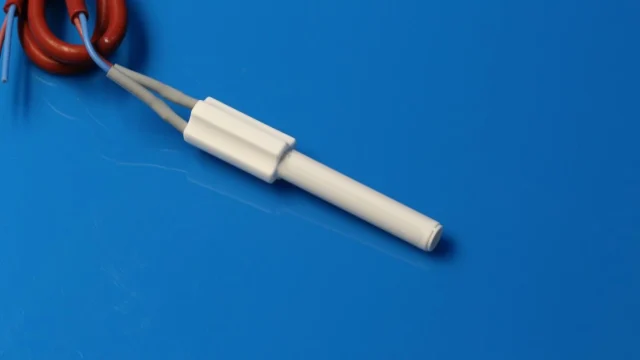
A hair straightener does not have much work to do before it is ready for styling — but the heating system has to do it quickly. From the moment the power is switched on, the heating element begins transferring heat to the plate, bringing it from room temperature to the temperature needed for styling. How long that takes can vary significantly depending on the heater and the way the heating assembly is designed.A short heat-up time is certainly convenient, but getting there quickly is not the whole story. The plate also needs to heat evenly, avoid excessive temperature overshoot and recover quickly when heat is lost during use. This is why the design of the heating element matters. Factors such as power density, heater size, thermal mass, heat transfer and temperature control can all affect how the system heats up.
For a ceramic heating element, these factors need to be considered together. They can affect both the heating speed and the temperature stability of the heating plate.
I. What Do We Mean by Heat-up Time?
Heat-up time is the period from switching on the straightener to the moment when the heating plate reaches the required temperature. For example, if the plate starts at 25°C and reaches 180°C after 25 seconds, the recorded heat-up time is 25 seconds.
The measurement itself is simple, but the result can vary between products depending on how the test is performed.
The temperature measurement point is one factor to consider. A reading taken from the centre of the plate may not be the same as a reading taken closer to the edge. The structure of the heating plate also affects the result, as a thicker plate usually requires more energy to reach the same temperature. The selected target temperature matters as well, since reaching 125°C and reaching 180°C represent different heating requirements.These measurements are not necessarily wrong. They are simply based on different conditions.
That is why a heat-up claim such as “heats up in X seconds” needs some context. The starting temperature, target temperature, input power, measurement point and overall heater construction can all affect the result.
II. Why Does Heat-up Time Matter?
A shorter warm-up period means less time waiting for the straightener to be ready. That can make a noticeable difference when the product is used on a tight schedule, whether it is part of a morning routine at home or being used repeatedly in a salon.
But reaching the target temperature quickly is only one part of the heating performance. Once the plate reaches 180°C, the system still needs to keep it close to that temperature during use.
Take two straighteners with the same 180°C target. One straightener may reach 180°C quickly, but the temperature can keep rising before it settles down. Another may take a few seconds longer to reach 180°C, but the temperature stays closer to the set value once it gets there. The second design can provide a more predictable heating performance in actual use.
This becomes more noticeable when working with thicker sections of hair.When the plates come into contact with the hair, they lose some of their stored heat. The plate temperature may drop, so the heating system needs to respond quickly and bring it back to the set temperature. A heater that recovers slowly may leave the plate below its intended operating temperature for longer.
The initial heat-up and the temperature recovery are therefore closely connected. A system that heats quickly but struggles to maintain its temperature may not perform as well as its initial heat-up time suggests.
The same applies to temperature uniformity. If one area of the plate becomes much hotter than another, increasing the overall heating speed does not solve the problem. The heater needs to deliver enough power while keeping the temperature reasonably even across the working surface.
The first few seconds only show how quickly the plate heats up. What happens after that also matters. The system needs to keep the plate at the right temperature and react quickly when the temperature drops during use.Simply increasing the input power cannot guarantee all three.
III. How Do You Measure It Fairly?
To compare heat-up times, the test conditions should be kept the same. A simple test setup can include the following:
| Test Parameter | Example Condition |
|---|---|
| Ambient Temperature | 25 ± 2°C |
| Initial Temperature | 25°C |
| Target Temperature | 180°C |
| Input Power | 40 W |
| Measurement Point | Centre of Heating Plate |
| Recording Interval | Every 5 s |
The plate temperature is checked at regular intervals and recorded on a time-temperature curve. The curve makes it easy to see how quickly the plate heats up and when it reaches the target temperature.
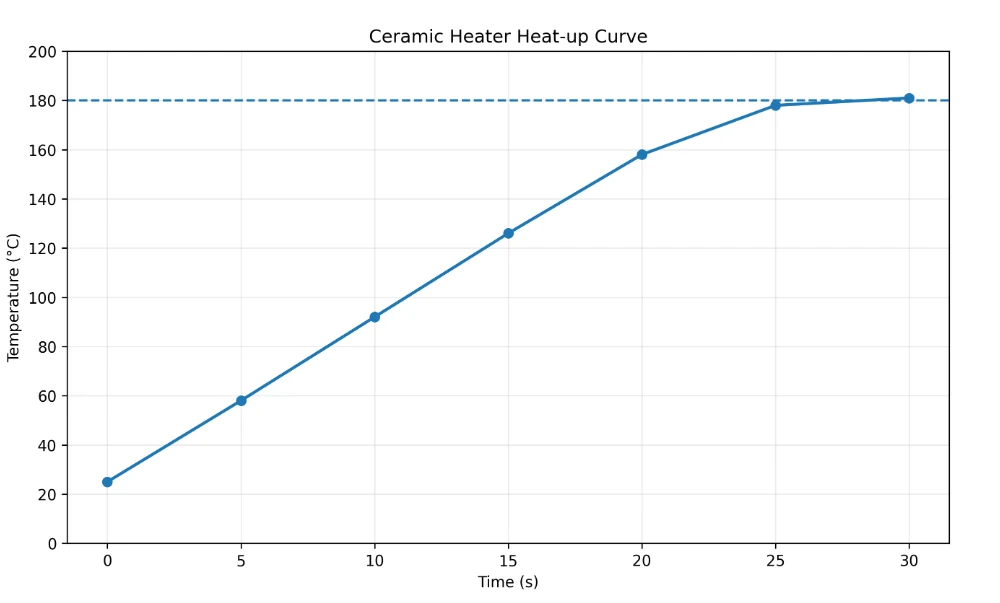
In the example below, the plate reaches about 180°C between 25 and 30 seconds. The temperature rises quickly at the beginning and then becomes slower as it gets closer to the target. At higher temperatures, more heat is released to the surrounding air and other parts of the heating assembly. So, the temperature rise gradually slows down during the later part of the test.
The actual result can be different from one design to another. The type of heater, plate thickness, bonding method, thermal interface and controller settings can all affect the result. For this reason, the same test conditions should be used when comparing different heating systems.
IV. What Affects How Fast It Heats?
Power Density
Power density refers to the amount of electrical power applied to a specific heating area.Power density affects how quickly the heating plate warms up.
Two heaters may both use 40 W, but they can still heat at different rates. This is because the same amount of power can be spread over different heating areas.For example, when the same 40 W is concentrated over a smaller active area, the power density is higher.
This can make the temperature rise faster in that area,the power density will be higher. This can produce a faster temperature rise in that area. For a hair straightener designed for a short heat-up time, having enough power concentrated in the active heating zone can be useful.
However, higher power density does not automatically mean better heating performance.Putting too much power into a small area can cause the centre of the plate to heat up much faster than the rest of the surface. This can create hot spots and leave the plate with an uneven temperature. When the centre is much hotter than the edges, the heat reaching the hair will also be less consistent.It can also make it harder for the temperature control system to keep the whole plate at the desired temperature.The controller may need to reduce the input power before the rest of the plate has reached the desired temperature.
For this reason, power density needs to be considered together with the size and shape of the heating area. The goal is not simply to maximise the number of watts per square centimetre, but to provide enough power for a fast heat-up while keeping the temperature reasonably uniform across the working surface.
In practical heater design, there is therefore a point where increasing power density further may bring less benefit than expected. The goal is to heat the plate quickly while keeping the temperature even and easy to control.
Heater Size and Thermal Mass
Heater size alone does not determine how quickly a heating system reaches its target temperature. A larger heater is not necessarily slower, and a smaller heater is not automatically faster. What matters more is the amount of power being supplied relative to the amount of material that needs to be heated.
Take a ceramic heater attached to a thick aluminium plate. The heater does not only have to heat itself. It also needs to bring the aluminium plate up to 180°C. The heavier the plate, the more energy it takes to heat the whole assembly. Using less material can therefore help shorten the initial heat-up time.But there is a trade-off. The heating plate still needs enough thermal capacity to prevent a large temperature drop when it touches the hair. If the thermal mass is too low, the plate will lose heat more easily during use, which means the heater and temperature control system need to work harder to maintain the set temperature.
This means that the ideal design is not necessarily the smallest or lightest possible heating assembly. Instead, the heater and plate need to be matched to the required operating conditions.
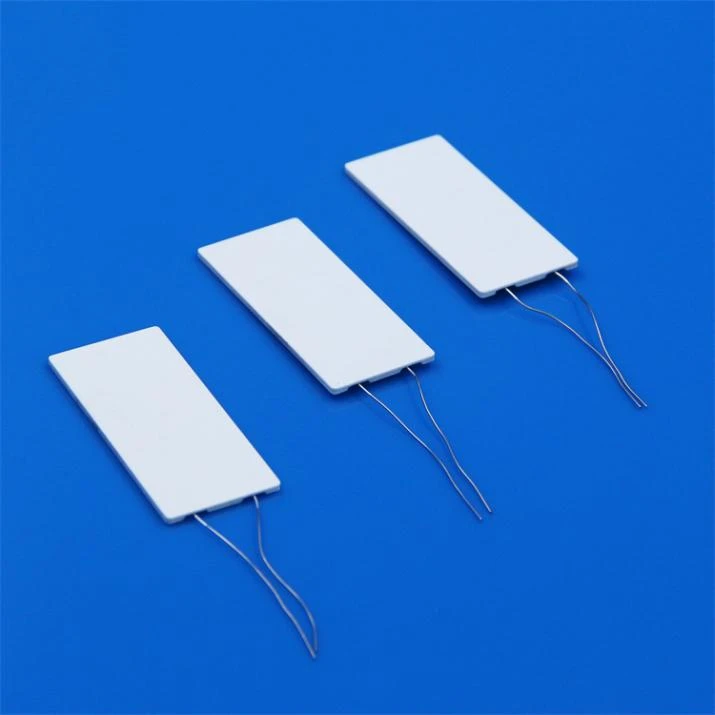
For ceramic heating sheets, this means considering the footprint, thickness, total weight and input power together rather than looking at any one dimension in isolation. The relationship between the power going into the system and the total mass being heated gives a much better indication of its potential heat-up performance.
This balance becomes even more important in compact and cordless appliances. Smaller products have less space available for the heating system, and battery-powered devices also need to use energy carefully. Reducing unnecessary thermal mass can help the heater reach the target temperature faster and lower the energy needed during the heating process.
Thermal Mass
Thermal mass describes how much thermal energy a component needs to absorb as its temperature increases. In a hair straightener, the ceramic heater is only one part of the thermal system. The heating plate and other parts connected to the heater also need to absorb heat during the warm-up process. The relationship can be described as:
Q = m × c × ΔT
where:
- Q is the required thermal energy
- m is the mass
- c is the specific heat capacity
- ΔT is the temperature increase
Take a 10 g ceramic heater with a specific heat capacity of 0.8 J/g·K. If its temperature rises from 25°C to 180°C, the temperature change is 155°C:
Q = 10 × 0.8 × 155 = 1,240 J
If the heater receives 40 W of power and we assume, for this simplified calculation, that none of the energy is lost to the surroundings, the theoretical heating time is:
1,240 ÷ 40 ≈ 31 seconds
This gives us a useful reference point, but it should not be treated as the expected heat-up time of the complete straightener.
The calculation above applies only to the ceramic heater itself. In an actual hair straightener, the metal heating plate also needs to be heated and may have considerably more thermal mass than the ceramic element. Energy is also lost during the process through conduction, convection and radiation.
The actual heat-up time will therefore normally be longer than the theoretical value calculated from the heater alone.
This distinction is important when evaluating heating performance. A ceramic heater may have a fast thermal response on its own, but the final heat-up time of the product depends on the entire heating assembly. For this reason, controlling thermal mass is an important part of designing a fast and stable heating system.
Temperature Control
Reaching 180°C is not the end of the heating process. When the plate gets close to the set temperature, the controller needs to adjust the power output to avoid the temperature going too high.
A good control system does not keep the heater running at full power all the time. Instead, it reduces the power as the temperature approaches the target and keeps the plate temperature within a stable range.A poorly matched control system can behave differently. If the heater continues receiving high power after the plate has nearly reached the set point, the stored heat in the heating assembly may continue pushing the temperature upward. The plate could then rise well above the target before eventually cooling back down.
For a hair straightener, this matters beyond the initial warm-up period.During styling, heat moves from the plate to the hair, causing the plate temperature to decrease. The heater and controller need to react quickly to bring the temperature back to the desired level.
A quick warm-up is useful, but the performance of a heating system depends on what happens after the plate reaches the target temperature. It also needs to keep the temperature steady and respond quickly when heat is lost during use.
Heat Transfer
The heater itself is only one part of the thermal path. Heat generated inside the ceramic heating element needs to reach the surface of the heating plate efficiently if the product is to achieve a fast and uniform response.
The connection between the heater and the plate can make a significant difference. The bonding method, interface material, contact area and position of the heater all influence how easily heat moves from the heating element into the plate.
A poor thermal connection can introduce additional thermal resistance. An air gap, for example, can make heat transfer less efficient and create a noticeable difference between the temperature of the heater and the temperature measured at the plate surface.
The construction of the heating plate also matters. Its material, thickness and shape affect how heat spreads after it leaves the ceramic element. A heater may therefore have a fast internal response while the actual plate surface takes longer to reach the target temperature.
Two hair straighteners can use similar ceramic heating elements but still have different heating results. The difference does not only come from the heater itself. The way the heater is attached to the plate, the contact between materials and the overall product design can all affect heat-up time and temperature distribution.
Heat transfer needs to be considered when designing the heating system from the start. Choosing the heater first and looking at heat transfer later may affect the final performance of the product.
V. So How Fast Can We Expect It to Be?
There is no single heat-up time that applies to every hair straightener.
With a well-matched design, a ceramic heating system can bring a heating plate to its working temperature within tens of seconds. The actual result depends on the heater power, power density, thermal mass, plate construction, heat transfer and temperature control.
The heating result is not decided by power alone. A higher input power may help shorten the warm-up time, but other factors, such as temperature uniformity, stability and energy use, also depend on the overall design of the heating system.Therefore, at the early stage of product development, the selection of the heater and the thermal design must be considered simultaneously.
VI. Why Ceramic Heating Sheets Are Used in Small Appliances
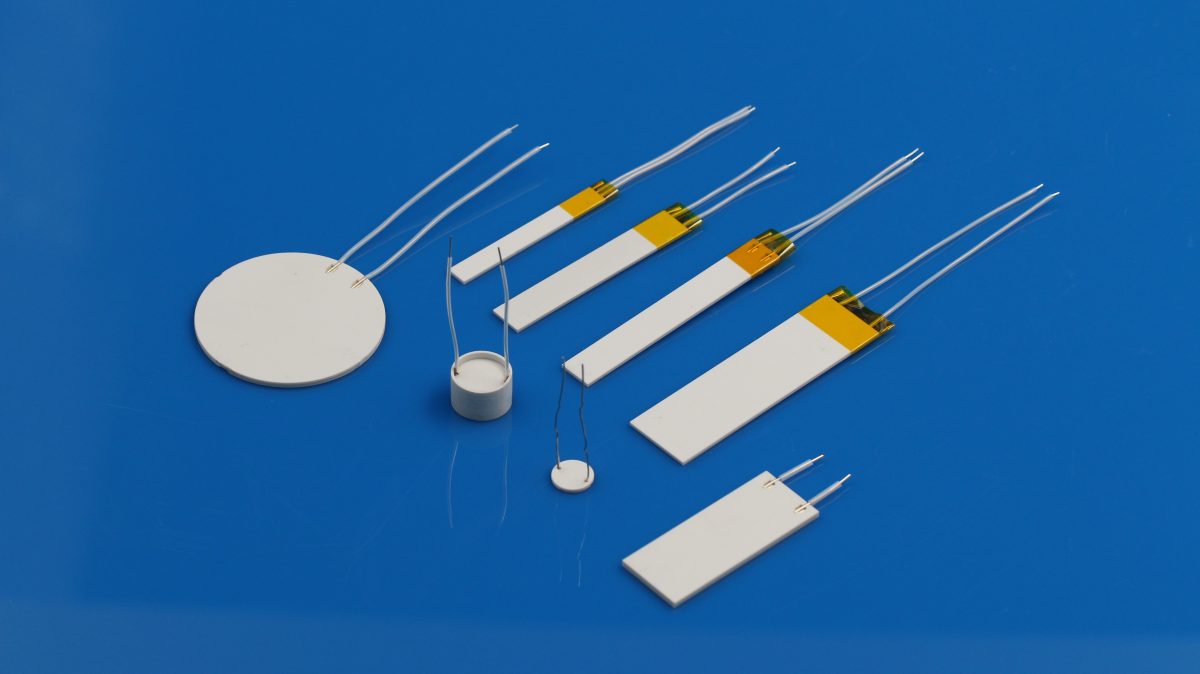
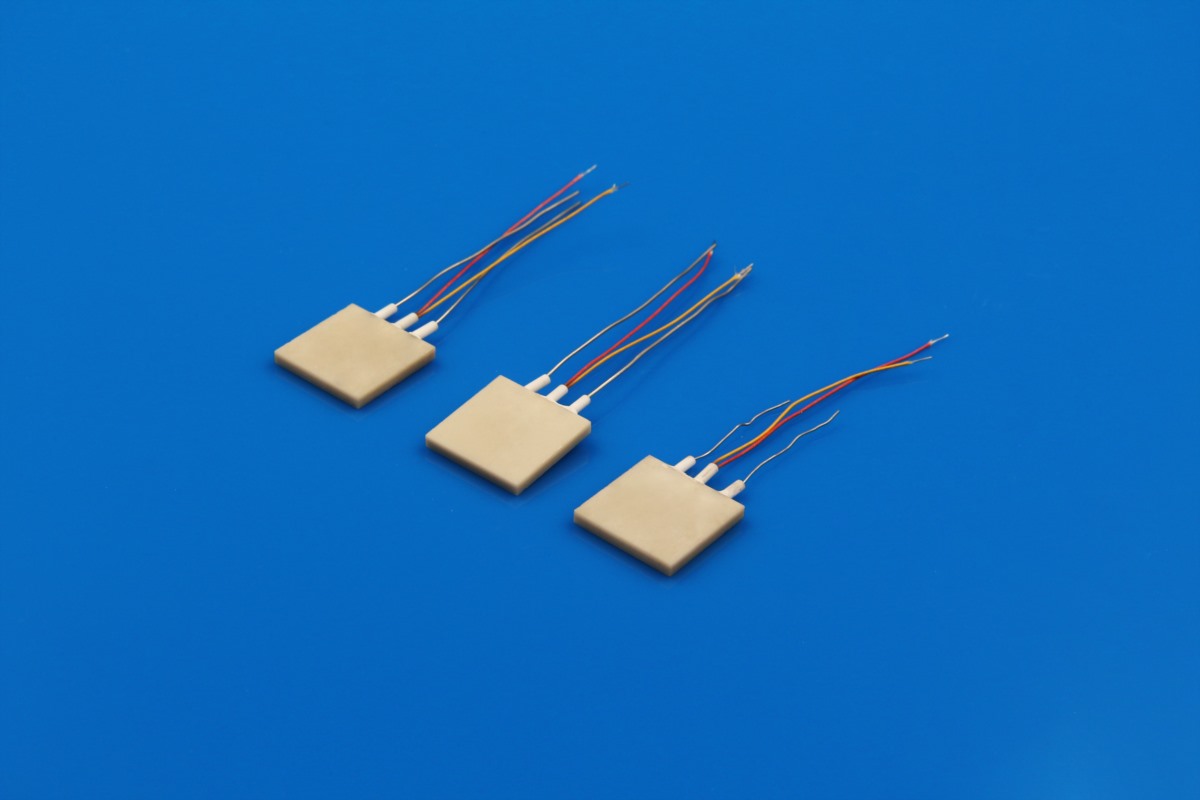
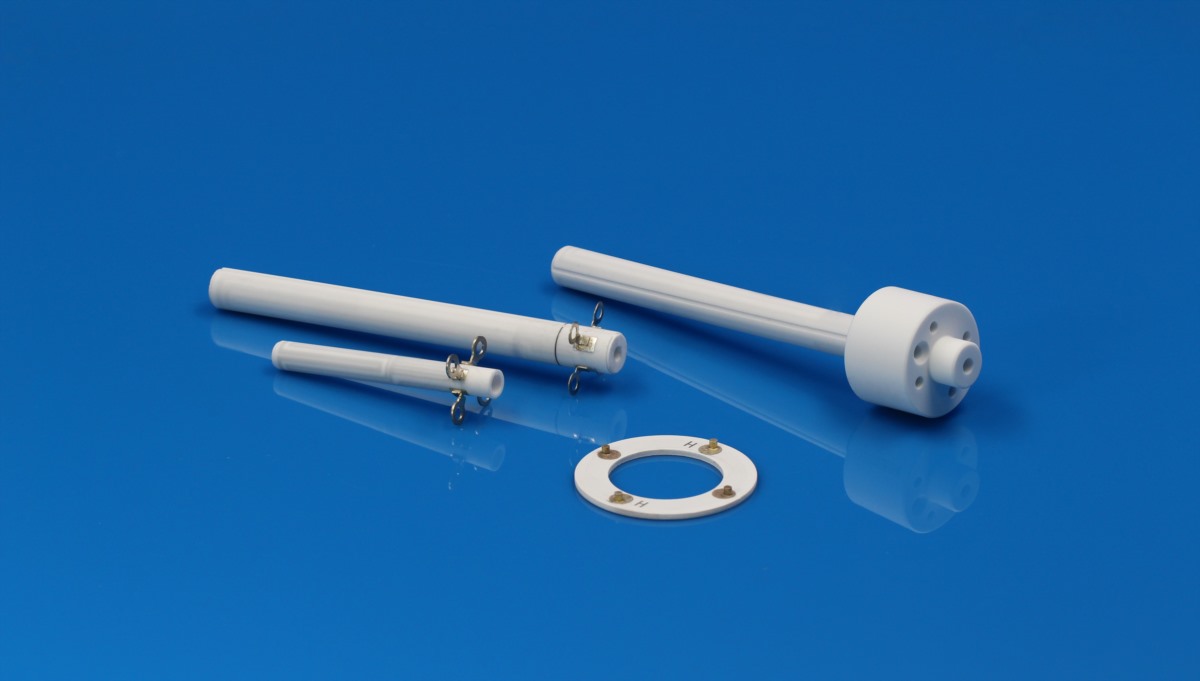
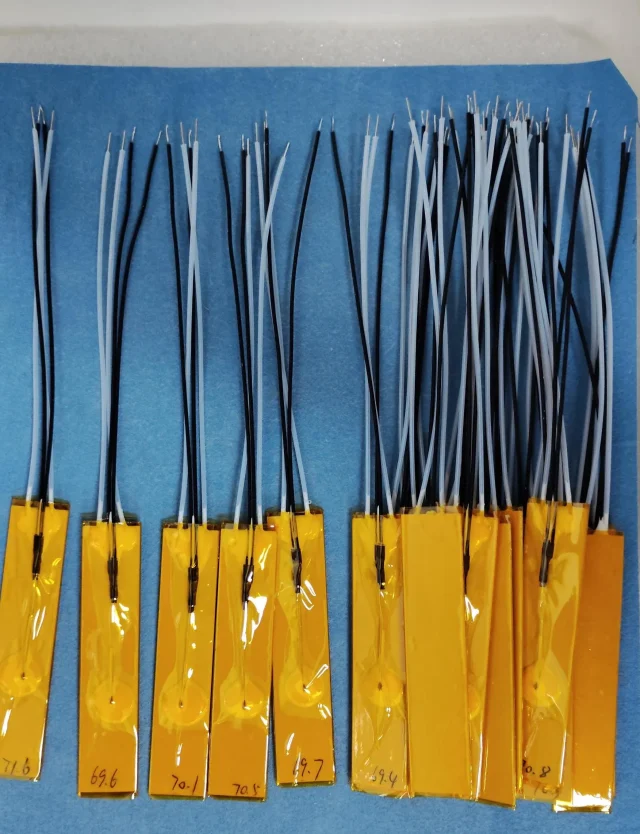
Ceramic heating sheets are well suited to small household appliances because these products often have to deliver a relatively high heating performance within a limited amount of space. Unlike larger heating equipment, small appliances have less room for bulky heating components, while users still expect them to heat up quickly and operate consistently.
Compact and Lightweight
Space is one of the first constraints in a small appliance. Hair straighteners, curling irons, kettles and milk warmers all need to fit the heating system into a relatively compact internal structure.
Ceramic heating sheets can be made in thin and compact configurations, allowing the heating element to be positioned closer to the working surface without taking up unnecessary internal space. Their lightweight construction can also help reduce the overall weight of the appliance, which is particularly useful for handheld products such as hair straighteners and curling irons.
For product designers, this gives more flexibility when arranging the heater, heating plate, insulation and other internal components.
Efficient Use of Energy
Energy efficiency becomes particularly important in compact appliances because there is usually limited space for the heating system and, in cordless products, a limited battery capacity.
A heating element that can transfer heat effectively to the working surface helps reduce unnecessary energy consumption during the heating process. The goal is not simply to use less power, but to make better use of the power that is supplied to the heater.
For battery-powered hair straighteners and other cordless appliances, this can be especially important because every watt used for heating directly affects available operating time.
Reliability for Repeated Heating Cycles
Small household appliances are often switched on and off repeatedly during their service life. A hair straightener may be heated, used for a short period, switched off and then heated again the next day. The heating element therefore needs to tolerate repeated thermal cycling.
A reliable heating system should maintain its thermal performance over repeated heating and cooling cycles while remaining stable within the intended operating temperature range.
This makes reliability an important consideration when selecting a heating element, particularly for appliances designed for frequent everyday use.
VII. Wrapping Up
How fast can a ceramic heater heat up a hair straightener?
There is no universal number. Heat-up time depends on how the heater, heating plate and control system work together.
Power density, heater dimensions, thermal mass, heat transfer and temperature control all have a role to play. A well-designed ceramic heating system can quickly heat the hair straightener to its operating temperature and maintain a stable and uniform surface temperature during use.
For manufacturers developing compact appliances, ceramic heating elements provide a practical way to achieve fast response, stable temperature control and reliable operation.
If you are developing a hair straightener or other small household appliances and have set specific heating targets, it is recommended to consider the heating design in the early stage of product development. The reasonable balance among the power of the heater, heat capacity, and the structure of the heating plate has a significant impact on the final effect.
Are you looking for a ceramic heating solution for your next small household appliance project? Contact the Innovacera engineering team to discuss your requirements.
Email: sales@innovacera.com