technical ceramic solutions

News

Category Archives: News

Ceramic Valve Core For Coca-Cola Machine

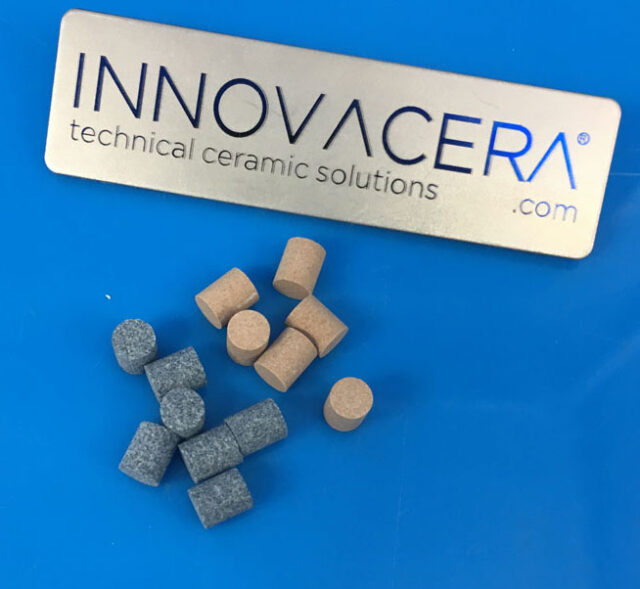
A ceramic valve core for a Coca-Cola machine refers to a component used in the dispensing system of the machine that controls the flow of the beverage. The valve core is a small, cylindrical piece made of ceramic material that is inserted into the machine’s dispensing mechanism.

The use of ceramic valve cores in Coca-Cola machines is preferred over other materials such as plastic or metal due to their durability and resistance to corrosion. Ceramics is also an excellent material for maintaining the flavor of the beverage as it is non-reactive, meaning it does not absorb any flavors or odors from the beverage.

The valve core is responsible for regulating the flow of the beverage through the machine’s dispensing system, controlling the amount of liquid dispensed per use. It is an essential component of the machine and should be regularly maintained to ensure optimal performance.

If you are in need of a replacement ceramic valve core for your Coca-Cola machine, you can contact the ceramic components manufacturers such as Xiamen Innovacera Advanced Materials Co., Ltd. or a certified repair technician to obtain one. It is important to ensure that the replacement part is compatible with your specific model of machine to ensure proper installation and operation.

Ceramic Valve Core For Coca-Cola Machine

Ceramic Valve Core For Coca-Cola Machine

Ceramic Valve Core For Coca-Cola Machine

Ceramic Valve Core For Coca-Cola Machine

spensing valve for coke machineSoda dispensing head valve high quality

dispending valve for coke machineSoda dispensing head valve high quality

Dispensing Valve For Coke Machine

Dispensing Valve For Coke Machine

The ceramic valve core ( ceramic spool ) used in the Coke machine usually needs to have high sealing and corrosion resistance, as the valve core needs to be constantly switched on and off and in contact with the beverage.

The valve core made of ceramic material has the following advantages:

  • Strong corrosion resistance: ceramic material is not easy to acid, alkali, salt, and other substances erosion, so the valve core can be used for a long time without easy corrosion damage.
  • High hardness: ceramic material has a high hardness so that the surface of the valve core can resist wear and scratches, improving the service life of the valve part.
  • Good sealing: The smooth surface of the ceramic material allows a tighter seal between the valve core and the seat to prevent beverage leakage.
  • Cleanliness: Ceramic materials do not release harmful substances, and are more hygienic to use and easier to clean.

Therefore, ceramic valve core is widely used in the manufacture of Coca-Cola machines, which provides an important guarantee for the performance and reliability of Coca-Cola machines.


Aluminum Nitrides (AlN) nozzles for Plasma Etch Equipment

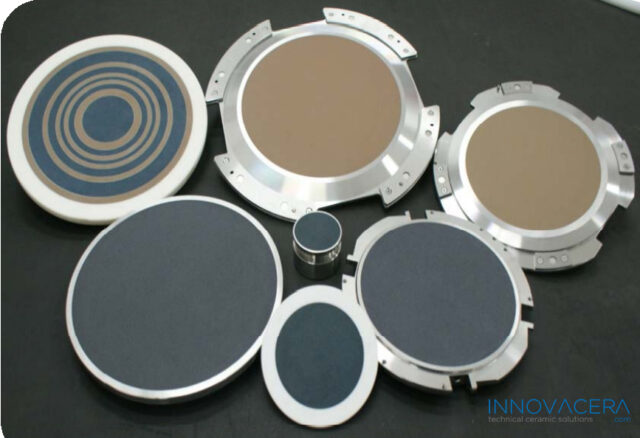
High-Resistance Process-Grade Aluminum Nitride (AlN) is an ideal material for many semiconductor equipment and applications.

Innovacera designs Aluminum Nitrides (AlN) nozzles for precise gas flow rate and uniform control to evenly disperse gases into the etch process chamber. These components require high plasma resistance, dielectric strength, and strong corrosion resistance to the process gases and byproducts.

Aluminum Nitride Material Properties
Properties INC-AN180 INC-AN200 INC-AN220
Color Gray Gray Beige
Main Content 96%ALN 96%ALN 97%ALN
Main Characteristics High Thermal Conductivity, Excellent Plasma Resistance
Main Applications Heat Dissipating Parts, Plasma Resistance Parts
Bulk Density 3.30 3.30 3.28
Water Absorption 0.00 0.00 0.00
Vickers Hardness(Load 500g) 10.00 9.50 9.00
Flexural Strength >=350 >=325 >=280
Compressive Strength 2,500.00 2,500.00
Young’s Modulus of Elasticity 320.00 320.00 320.00
Poisson’s Ratio 0.24 0.24 0.24
Fracture Toughness
Coefficient Linear Thermal Expansion 40-400 degree Celsius 4.80 4.60 4.50
Thermal Conductivity 20 degree Celsius 180.00 200.00 220.00
Specific Heat 0.74 0.74 0.76
Thermal Shocking Resistance
Volume Resistivity 20 degree Celsius >=10-14 >=10-14 >=10-13
Dielectric Strength >=15 >=15 >=15
Dielectric Constant 1MHz 9.00 8.80 8.60
Loss Tangent *10-4 5.00 5.00 6.00
Remark: The value is just for review, different using conditions will have a little difference.

Kindly contact us for more details if you are working in this field

We’d love to discuss how our materials can offer you a solution.

Aluminum Nitrides (AlN) nozzles for Plasma Etch Equipment

Aluminum Nitrides (AlN) nozzles for Plasma Etch Equipment


New Silicon Nitride Metalized Substrates now available from Innovacera

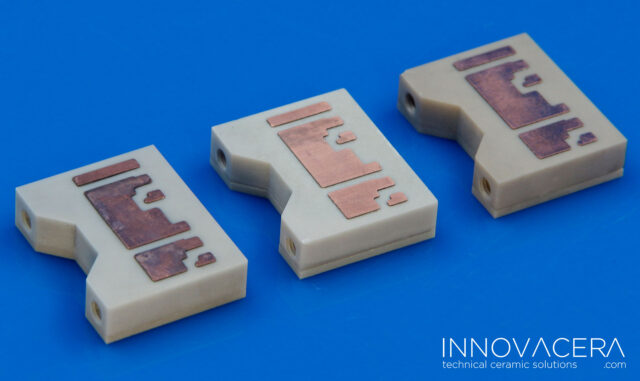
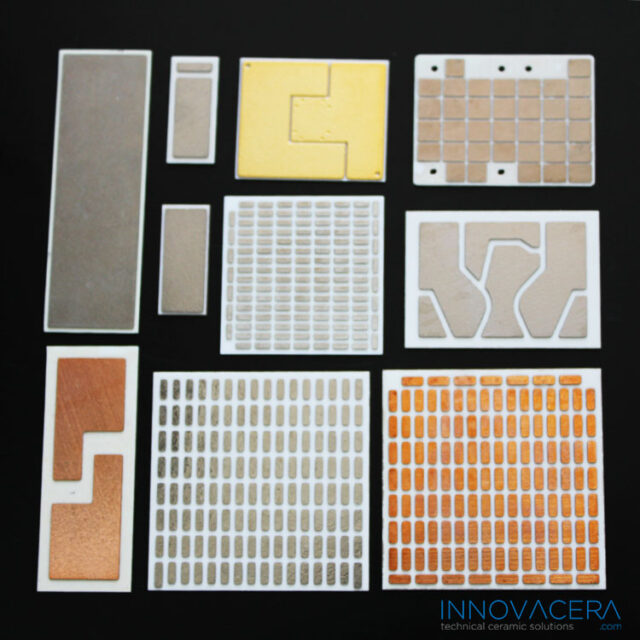
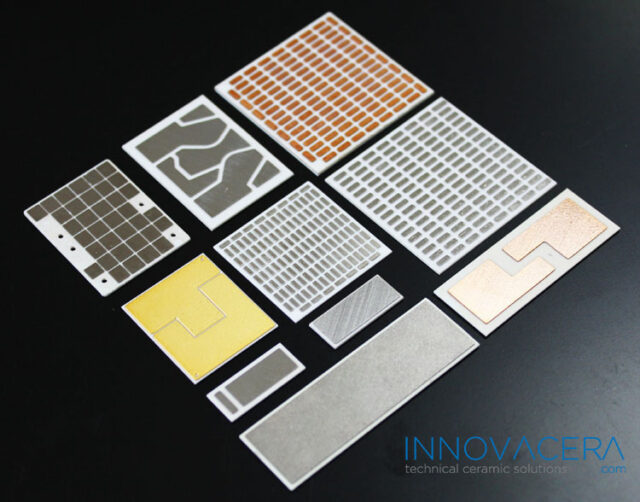
Xiamen, China – Innovacera, a leading manufacturer of advanced materials, is proud to announce the release of its latest product: Silicon Nitride Metalized Substrates including the Silicon nitride SI3N4 Ceramic AMB  (Active Metal Bonding) substrates.

Designed for use in a wide range of industrial applications, these new substrates offer excellent mechanical and electrical properties, making them ideal for use in high-performance electronic devices.

The Silicon Nitride Metalized Substrates are fabricated using advanced processes and state-of-the-art equipment, ensuring the highest level of quality and reliability. They feature a metalized surface that allows for excellent bonding and soldering, making them ideal for use in advanced electronic packaging applications, especially the SI3N4 Active Metal Bonding substrates, it is widely used for the Automobile new energy industry.

“We are excited to introduce our latest product to the market,” said Innovacera spokesperson Mr. Qiu. “Our Silicon Nitride Metalized Substrates are the result of years of research and development, and we are confident that they will offer our customers significant benefits in terms of performance and reliability.”

In addition to their superior mechanical and electrical properties, the Silicon Nitride Metalized Substrates are also highly resistant to thermal shock and chemical corrosion, making them ideal for use in harsh environments. They are available in a range of sizes and thicknesses, making them suitable for a wide range of applications.

For more information on the Silicon Nitride Metalized Substrates and other advanced materials from Innovacera, please visit our website at www.innovacera.com.

New Silicon Nitride Metalized Substrates now available from Innovacera

New Silicon Nitride Metalized Substrates now available from Innovacera

About Innovacera:

Innovacera is a leading manufacturer of advanced materials, serving a wide range of industries worldwide. With a commitment to innovation and quality, we are dedicated to providing our customers with the highest level of service and support.


What’s Is Machinable Glass Ceramic?

Machinable Glass Ceramic is a mica glass ceramic material with a unique combination of properties. It is easily machinable using conventional metalworking tools, with no post-firing required. A versatile ceramic material with technical strength and insulation properties exceeding high-performance plastics, it is also stable in high temperatures (continuous at 800° Celsius, up to a peak of 1,000° Celsius) with 0.0069% porosity. The ceramic material also acts as an electrical insulator that is radiation resistant and has low thermal conductivity.

Machinable Glass Ceramic

Machinable Glass Ceramic

Characteristics include:

1.0.0069% porosity and non-shrinking

  1. High dielectric strength
  2. Electrical resistivity
  3. Withstands high temperatures up to 800ºC
  4. Tight tolerance capability
  5. Easily and economically machined into complex shapes and precision parts

Applications include:

  1. Feedthroughs
  2. Hermetic seals
  3. Insulators and supports for vacuum environment feed-throughs

Spacers, headers, and windows for microwave tube devices

  1. Aerospace components
  2. Welding nozzles

7. Fixtures


BN-TiB2 Boron Nitride Ceramic Crucible for High Power of Electron Beam

BN-TiB2 crucible is often used for electronic beam evaporation. The material is with electric conduction.


Technical Data:

Material: BN+TiB2

Binder: B2O3

Color: Grey

Electrical resistivity(room temperature): 300-2000uΩ.cm

Working temperature: <1800℃

Thermal Conductivity: >40 W/mK

Coefficient of thermal expansion:4-6×10^-6K

Bending Strength: >130Mpa

Evaporation Rate: 0.35-0.5 g/min.cm2

BN-TiB2 Boron Nitride Ceramic Crucible for High Power of Electron Beam

BN-TiB2 Boron Nitride Ceramic Crucible for High Power of Electron Beam


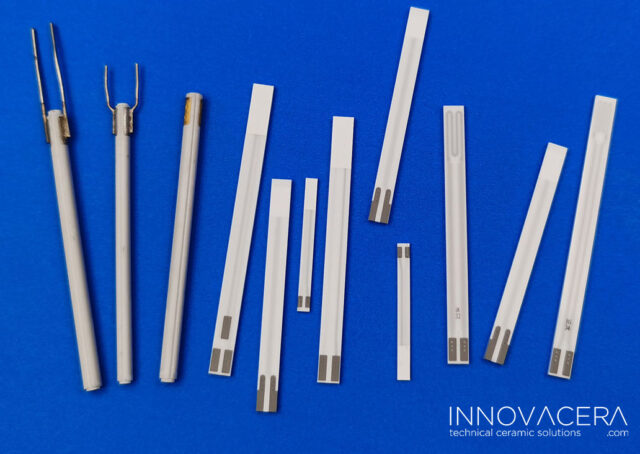
Types of oxygen sensors

According to the substance used in their sensitive element, are:

Zirconium (zirconium oxide)

Titanium (titanium oxide)

Wideband

According to their design:

Single-wire lambda sensor

Two-wire lambda sensor

Three-wire lambda sensor

Four-wire lambda sensor

Single-wire lambda sensor was used in the early injection systems with feedback (lambda regulation). It has only one terminal, which is the signal terminal. Sensor ground is its housing and it connects to the engine ground through the exhaust pipes.

Two-wire lambda sensor has a separate grounding cable. It was used in the early injection systems with feedback (lambda regulation) also.

The disadvantage of the single-wire and the two-wire sensors is that their operating temperature range starts at 300 ºC. The sensor will not work and will not produce a signal until this temperature is reached. It was necessary for the sensor to be mounted as close to the engine cylinders as possible in order to heat and wrap from the hottest exhaust gas stream. The process of heating the sensor slows down the regulation process of the onboard controller because of the feedback. In addition, using the exhaust pipe as a signal ground requires the sensor’s thread to be coated with a special electrically conductive paste, which increases the possibility of a bad contact in the feedback circuit.

Types of oxygen sensors

Types of oxygen sensors

In the three-wire lambda sensors, is a special heating element inside which is constantly turned on when the engine is working and thus it’s reducing the heating time of the sensor to the working temperature. This allows the installation of the sensor on the exhaust manifold, near the catalytic converter. The disadvantage is the need for electrically conductive grease.

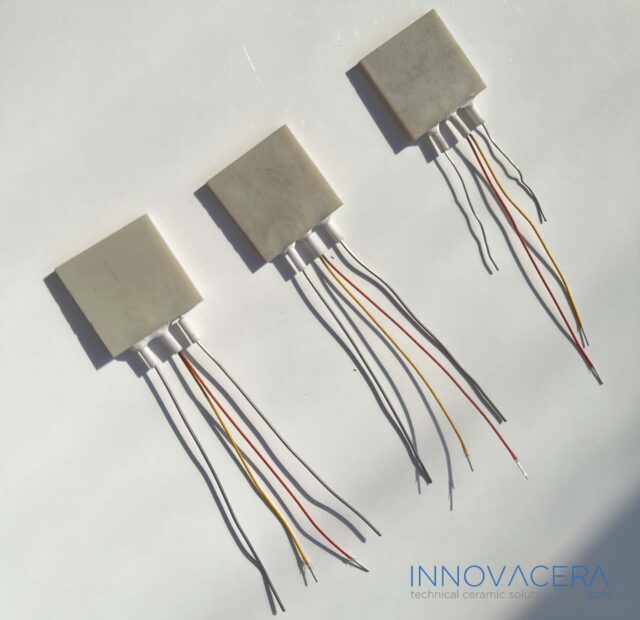
In the four-wire oxygen sensors – two of the terminals are the heater terminals and the other two, are the signal termina

If you want to know more, pls contact us.


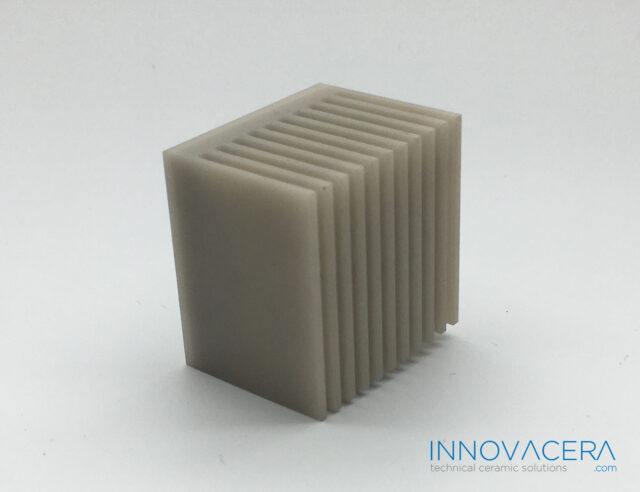
What Is Ceramic Heat Sink?

Components of modern technology products, such as computer chips or light-emitting diodes, generate more and more waste heat during operation, and generally existing heat dissipation devices used to assist heat dissipation components usually include at least a metal heat sink and a The fan conducts the waste heat from the operation of the heating element through the heat sink to remove it by air convection, and uses the fan to forcibly accelerate the convection of the air around the heating element to achieve the effect of rapid heat removal.
However, the heat transfer coefficient of existing metal heat sinks is not very good. Therefore, heat sinks made of ceramic materials with better heat transfer characteristics appear on the market in order to achieve better heat dissipation effects.

Ceramic heat sink classification

There are aluminum oxide heat sink, aluminum nitride heat sink and silicon carbide heat sink.

There is the performance comparison between usual heatsink VS ceramic

Temperature of Heater itself
(Without heat sink)
Temperature of heater with heat sinks
Usual heatsink Ceramic heatsink Difference ΔT
150℃ 90.3℃  86.7℃  3.6℃
180℃  119.1℃  110.8℃  8.3℃
250℃  175.4℃  164.3℃  11.1℃

Advantages of Ceramic Heat sink:

1. Do not store heat, and dissipates heat directly, which is fast and reduces the influence of the insulating layer on thermal efficiency;

2. The polycrystalline structure of the ceramic heat sink enhances heat dissipation. Year-on-year conditions, surpassing most thermal insulation materials on the market;

3. The multi-directional heat dissipation of the ceramic heat sink accelerates heat dissipation;

4. High thermal conductivity, high voltage resistance, high temperature resistance, wear resistance, high strength, oxidation resistance, acid and alkali resistance, long service life, and low thermal expansion coefficient, ensuring that it can be used in high and low temperature environments or other harsh environments.

5. Effective in anti-interference (EMI) and anti-static;

6. It is made of natural organic materials, which meets the requirements of environmental protection;

7. Small in size, light in weight, high in strength, saves space, saves materials, saves freight, and is more conducive to the rational layout of product design;

8. Withstand high current, high voltage, prevent leakage and breakdown, has no noise, and will not generate coupling parasitic capacitance with power tubes such as MOS, and thus simplifies the filtering process; the required creepage distance is higher than that of metal bodies The short requirement further saves board space, which is more conducive to the design of engineers and the passing of electrical certification.

Applications:

1. Ceramic heat sinks are mainly used in high-power equipment, IC MOS tubes, IGBT chip-type heat-conducting insulation, high-frequency power supplies, communications, mechanical equipment, high-current, high-voltage, high-temperature and other product components that require heat conduction and heat dissipation insulation.

2. LED lighting, high-frequency welding machine, power amplifier/audio, power transistor, power module, chip IC, inverter, network/broadband, UPS power supply, high-power equipment, etc.

What Is Ceramic Heat Sink


Injection Molding of Aluminum Nitride Ceramics

Ceramic Injection Molding (CIM) is an emerging technology for manufacturing complex-shaped ceramic parts, and it has incomparable unique advantages in the preparation of complex small parts. With the continuous expansion of the industrialization scale of electronic ceramics worldwide in recent years, the attractive application prospect of CIM technology is worth looking forward to. The process mainly includes material preparation, injection molding, debinding, and sintering.

Injection Molding of Aluminum Nitride Ceramics

Injection Molding of Aluminum Nitride Ceramics

① Material preparation. The sinterable ceramic powder is mixed with a suitable organic carrier (binder) at a certain temperature to provide the fluidity and green strength necessary for ceramic injection molding; the mixture system of ceramic injection molding is a high-solid Viscous suspension (or melt) with phase volume fraction, the volume fraction of solid particles (ceramic powder) reaches 50-70%.

② Ceramic Injection molding. After kneading, the extruded and granulated mixed material is heated and softened at a certain temperature by an injection molding machine, and then injected into the mold at high speed under pressure, cooled, and re-solidified in the mold to obtain the desired shape of the injection molded blank. Mold shape, mold temperature, feeding temperature, injection pressure, holding time, cooling speed, etc. all have an impact on the quality of the billet.

③ Debinding. The organic binder for injection molding is about 25-50% (volume percentage). How to effectively remove such a large amount of organic matter without affecting the distribution of particles is a very difficult thing. Degreasing is a physical and chemical reaction process, and its process control is complex, which may easily cause defects such as cracking, deformation, and voids in the green body. Therefore, whether the degreasing can be successfully completed is very important for ensuring the quality of the green body, high product qualification rate, reducing energy consumption, and large-scale production.

④ Sintering. After degreasing, ceramic injection molded products will have many pores inside and low density, so high-temperature sintering is required to obtain high-performance dense products. The sintering speed is related to viscous flow, condensation, volume diffusion, surface diffusion, etc. For non-oxides, nitrogen or other gases are generally used instead of air, and the sintering of oxide ceramics is generally carried out under air. Sintering is generally carried out at normal pressure, but for some ceramics that are easy to evaporate at high temperatures, it must be carried out under pressure.

Advantages: high density, uniform density distribution, can be used for complex shape green body molding, and high molding precision, no need for post-processing.

Disadvantages: Defects such as underfill, flash, weld marks, and air pockets are prone to affect the sintering of AlN ceramics.


Why Consider Ceramic Feedthroughs

Ceramic feedthroughs are ceramic-to-metal fabrications that are utilized to transmit electrical signals, high currents/gases/fluids, or high voltages from between external sources to a hermetically-sealed chamber.

Why Consider Ceramic Feedthroughs

Why Consider Ceramic Feedthroughs

Electrical connectors and feedthroughs require well-engineered materials. In its simplest form, epoxy or glue can be used to seal a joint, but a more robust solution might use an elastomer Oo-ring as a mechanical seal. But in the most demanding applications and to prevent leakage over, fluctuating changes of temperature, humidity, and pressure, a ceramic seal can be most effective.

These assemblies are made to provide high mechanical strength and electrical insulation. They are hermetically sealed and maintain very high levels of vacuum. Joint integrity is maintained even at extreme temperatures and in harsh environments.

Feedthrough Applications

Typical uses of ceramic feedthroughs:

Mass spectrometry

Gas detection

High-vacuum connectors

Transmission and scanning electron microscopes

Particle accelerators

Medical industry applications

X-ray equipment

Scanners

Imaging equipment

Aerospace industry application

Satellite propulsions

Sensors

Engines

Power tubes

Optoelectronics

Gas lasers

Rechargeable batteries

Deep sea penetrators and repeater

INNOVACERA supplies the most commonly used ceramic-to-metal bonded feedthroughs, which are utilized in many different applications with proven reliability.

If you have any inquiries, pls feel free to send them to us.


Pyrolytic Boron Nitride/PBN Ceramic MBE Crucible for Microelectronics Industrial

The molecular beam epitaxy ( MBE Crucible ) method is one of the methods to produce gallium arsenide epitaxy wafers. This method can be used to produce multiple, multilayer, homogenous, heterogenous, superlattice, and quantum well epitaxy materials. High crystal purity and good chemical stability. MBE Crucible is mainly used to synthesize semiconductor single crystal and ⅲ-ⅴ group compounds by MBE method.

Pyrolytic Boron NitridePBN Ceramic MBE Crucible for Microelectronics Industrial

Pyrolytic Boron NitridePBN Ceramic MBE Crucible for Microelectronics Industrial

MBE Crucible Main Features
1. Can make large crucible (maximum diameter 12inch, maximum height 17inch);
2. High density (up to 2.2g/cm3);
3. High purity (>99.99%);
4. Not easy to crack (high interlayer strength).

PBN Properties

Technical Parameter BN PBN


Mechanical

Density g/cm3 2.2~2.3 2.1-2.19
Color White White
Water Absorption % 0 0
Vickers Hardness Gpa (Moh’s=2) (Knoop=691)
Flexural Strength (20°C) Mpa 100 243.63
Compressive Strength (20°C) Mpa 287


Thermal

Thermal Conductivity (20°C) W/m.K 35 43-60
Thermal Shock Resistance (20°C) Δ T(C)
Maximum Use Temperature °C 2400 2200
Electrical Volume Resistivity (25°C) Ω.cm 10 ^ 8~10 ^ 13 3.11×10 ^ 11


Pyrolytic Boron NitridePBN Ceramic MBE Crucible for Microelectronics Industrial (2)

Pyrolytic Boron NitridePBN Ceramic MBE Crucible for Microelectronics Industrial (2)


Enquiry