technical ceramic solutions

News

Category Archives: News

How are advanced ceramic components made?

Advanced technical ceramics are generally produced on a relatively small scale. Expensive raw materials are used, but these are compensated for with the resultant improved properties and consistency.

The important processing of advanced ceramic components are produced by sintering (firing) compacted ceramic powder (raw material) forming. The form components are usually referred to as ‘green-state’ and numerous powder-forming processes have been developed including dry pressing, hot pressing, isostatic pressing (CIP and HIP), injection, slip casting and extrusion. However, the powder consists of solid, hard, brittle particulates, so it is difficult to consolidate in a die by pressure alone. A binder is usually added to enhance the flow properties of the powder, leading to higher density in the final component. The binders used vary according to the process to be used and the desired properties of the final product.

Once the ceramic powders have been compacted to produce the green-state component, they are approximately 50-70% dense. They are also relatively weak, but with care can be machined to quite complex geometries. To impart strength, the green state components are usually sintered.

Initial heating (up to 250°C) volatilizes any organic processing additives (binders) and decomposable constituents. As the temperature increases to the firing temperature, consolidation, or sintering of the ceramic powders (solid-state sintering) begins and is usually accompanied by shrinkage. This shrinkage must be accounted (designed) for when machining in the green-state.

Sintering can be assisted (decreasing temperature or time requirements) by the deliberate addition of additives which will react to produce lower melting point green-state been (liquid phase sintering). These secondary phases can be envisaged as “gluing” the ceramic particles together. This is the case for ceramics such as alumina. Sometimes, sintering aids are added to enhance diffusion (which aids sintering), this is the case when additions of boron or aluminum are added to hot-pressed silicon carbide.

A general flow diagram for ceramic processing is shown as linked.

Advance Ceramic Processing


How To Make Technical Ceramic Part By Low Injection Way – From Innovacera

1. Compounding Ingredient
Weigh and mix raw material powder in a certain proportion. In order to guarantee the quality from the first step, we do this step itself instead of buying already-mixed raw material.

2. Drying
Remove the moisture from raw material. Make sure the hardness of the finished product.

3. Ball-milling
Mixing the material while grinding by ball milling machine. The purpose of this step is to reduce the grain size of the powder and to make it fully mixed.

4. Sieving
Sieve to remove the impurity in the powder & dry it. (After this step, the grain size will be tested.)

5. Wax Placing
Heat solid wax into thick liquid. Add the powder and mix them up. Wax helps the ceramic raw powder to shape up. Then pour the mixture into a container, making it cool down and solidify into a solid block in the air.

6. Melting
The mixture solid is preheated to be slightly soft for easier transfer. The mixture is turned into a liquid at 90 ° C, and vacuum is applied. The purpose of vacuuming is to drive away air bubbles in the liquid and mix the slurry evenly. (The viscosity of the raw material will be tested after this step)

7. Forming
Keep the material in low injection machine under 65-70℃, to ensure the material does not solidify. Material is squeezed out from the machine into mold. It will shape up and harden when contacting air. (Mould are placed on ice blocks in order to cool them down. And the air blowing is to dry the mold.)

8. De-waxing and Glue Removing
Put the shaped-up product in the low-temperature room. After standing for a few days, it is sufficiently cooled and hardened, and then transferred to a crucible containing β-Al2O3 powder (the β-Al2O3 powder has an adsorption function, which can adsorb and remove wax or other glue which helps to form, and can be recycled). Then, it is placed in a medium temperature furnace at 1100 ° C for 53 hours, and the wax and glue removing is done after taking out the packaging. The finished product after this step is called pottery.

9. Sintering
Put the product on the setters (the bearing plate requires high-temperature resistance, the temperature should be around 1700 °C), into the high-temperature furnace calcine for 24 Hours (temperature is around 1650-1700 °C, depending on different material requirements), the finished product after this step is called ceramic. Tolerances of finished product are between ±0.1. The high-temperature furnace including a box furnace and a tunnel furnace. The tunnel furnace consumes a large amount of electricity and has a high cost, and is suitable for burning large quantities of products.

10. Cleaning
Firstly use ceramic beads to polish and rub the finished product to remove burrs and make the surface smooth. If there is no special requirement, usually the products are ultrasonically cleaned. Then products can be packed up and ship to our customers. If there are special requirements, the first step is also polished & rubbed through ceramic beads, and then do machine process in due course.

11. Machine
Machine processes include surface grinding, internal/external grinding. The internal grinding machine has a maximum grinding diameter of 100mm and a maximum grinding depth of 150mm. It is mainly achieved by the friction between the grinding wheel and the machining part. The precision can be up to 3μm. (The grinding wheel has different models. different grinding wheels for different precision.)


12.Inspection Equipment
a. Two-dimensional detector (detecting the appearance and size of the product);
b. Roughness detector;
c. Density detector;
d. Viscosity detector;
e. Bending and tensile strength tester;
f. Vickers hardness tester;
g. Laser particle size analyzer;
h. Manual inspection.


Ceramic igniter for pellet boiler

Ceramic igniter for pellet boiler

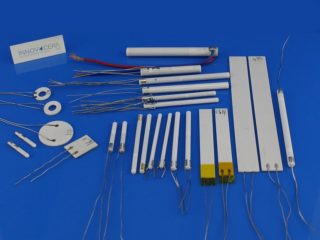
Our ceramic heating elements consist of Al2O3 insulation ceramics with an integrated W conductor, and reach a permanent operation temperature of between 800°C and 1000°C.

Igniter’ feature:
1. Heating applications above 750°C, in which standard heating cartridges would have long since failed.
2. Exact, rapid heating due to the extremely low thermal mass.
3. Efficient hot gas generation through the extremely large heat transfer surface area.

Igniter’ applications:
1. Hot surface igniters (ignition of gas, oil, biomass, pellets)
2. Hot air generation
3. Tool heating
4. Melting / Welting / Soldering / Hot air soldering
5. Heaters for chemical analysis and laboratory equipment (eg: min-furnaces, reactors)
6. Customer-specific heating solutions.

Igniter’ advantages:
1. Extremely fast and hot (Permanently at 1100°C, for the short term up to 1300°C)
2. Extremely energy-efficient
3. Resistant to thermal stress(rapid switching is easily tolerated)
4. Very corrosion-resistant
5. Practically non-ageing
6. Electrical contacts using patented high-temperature-resistant plug connector
7. Integrated temperature measurement possible using platinum conductor. Heater and sensor in one!

If you are interested in our ceramic igniter, please click here to contact us.


Happy Mid-Autumn Festival

Happy Mid-Autumn Festival

Innovaera will closed from Sept.13-Sept.15 for Mid-Autumn Festival.

Mid-Autumn Festival is a traditional festival in China. It used to be as important as Spring Festival is usually celebrated in the Lunar August 15. This festival is to celebrate the harvest and to enjoy the beautiful moonlight.

To some extent, it is like Thanks Giving day in the USA. On this day, people usually get together with their families and have a nice meal. After that, people always eat delicious moon cakes and watch the moon.

The moon is always very round on that day, and makes people think of their relatives and friends. It is a day of pleasure and happiness.

Hope you have a wonderful Mid Autumn festival!


What tests do ceramic heating elements have to do before they leave the factory?

Real-time data measured by infrared thermometer

What tests do ceramic heating elements have to do before they leave the factory?
1) Power-on test
2) Insulation resistance detection
3) Leakage Current Test
4) High-voltage insulation test
5) Peel force test
6) Temperature rise measurement
7) Life test
8) measurement
9) Appearance & Dimension test
10) Packing inspection
11) Other Special Requirements from customer

Here is some of our ceramic rod heater test video.
Video content:
1. Conventional power-on test
2. Power on test
3. Composite ceramics, lead does not fall off at 800℃ P1837
4. Life test
5. Temperature test (Temperature behavior at different voltages)
6. Real-time data measured by infrared thermometer
7. Infrared thermometer (range of 900 degrees), HHHH means out of range, over top 900℃
8. Power on the test, non-routine test
9. Power measurement, Innovacera hot surface igniter for Biomass Pellet Stove


Zirconia ceramics for the production of mobile phone backplanes

With the advent of the 5G era, zirconia ceramics have become the new favorite material for mobile phone backplanes.

By the end of 2018, 154 mobile operators around the world are conducting 5G technology testing or testing, and the number of countries participating in 5G has expanded to 66. With the advent of the 5G era, the mobile phone industry will usher in a new round of changes, and the mobile phone backplane market is facing a reshuffle. Among them, zirconia ceramics stand out in a new round of technical reshuffles.

Advantages of zirconia ceramics as raw materials for mobile phone back sheets.

The 5G era requires faster signal transmission, which is 1~100 times that of 4G. 5G communication will use the spectrum above 3Ghz, and the wavelength of the millimeter-wave is shorter. Compared with the metal backplane, the ceramic backplane has no interference to the signal and has unparalleled superior performance of other materials, which is favored by mobile phone manufacturers.

Comparison and difference between several major mobile phone backplane materials.

plastic metal glass ceramic
Exterior bad normal normal Great good
Feel bad
Coloring difficulty Simple, can do a variety of surface patterns Normal, prone to paint peeling Difficult, general film, coating adds texture Simple, can do a variety of surface patterns
Weight Thicker and lighter The thinnest and lightest Thicker, heavier Thickness control is generally
Rigidity Bad, Plastic deformation is obvious Normal, have a certain plastic deformation Good, Poor plastic deformability Good, Small plastic deformation
Brittleness normal good Bad, But still able to meet the drop test Significant plasticity enhancement after material modification, meeting the drop test
Hardness/wear resistance bad normal normal Great good
Heat dissipation bad good Very bad no effect
Cost lowest normal Higher
Electric porcelain shielding no effect, Integrated molding Great impact, need to be cut off with plastic No effect can be integrated

Among all ceramic materials, zirconia ceramics have the advantages of high strength, high hardness, acid and alkali corrosion resistance and high chemical stability, as well as scratch resistance, no signal shielding, excellent heat dissipation performance, good appearance, etc. Features, therefore become a new type of mobile phone body material after plastic, metal, glass. At present, the application of zirconia ceramics in mobile phones is mainly two parts of the backboard and the fingerprint identification cover.

zirconia ceramic balls

INNOVACERA Produced zirconia ceramic balls

Zirconia ceramic mobile phone backplane

Zirconia ceramic mobile phone backplane


The advantage of ceramic deburring cutters

Deburring Cutters

Zirconia Ceramic material is ideal for removing the burrs of plastic, metals and rubber. Because it is durable and has high hardness.

Our knife can smooth the edge and remove sprayed points and separation lines from mould halves. Furthermore, it is cabinet and easy to use avoid injury. Different kinds of blades can be replaced so that the cost is effective.

Canpared to traditional steel blades, ceramic blades have many benefits:
1. never rusts, no special oil coating or maintenance
2. light weight
3. stay edge and sharp
4. Very sharp
5. Corrosion resistant
6. non-conductive


How we test the life cycle of Alumina Ceramic Heater

1) The alumina ceramic heater power on for 3 minutes
2) Power off for 8 minutes
3) The life cycle test can be 3000 times without damaging

Video content:
Heating-up Test
Voltage and Current Test
Working Life Cycle Testing of Alumina Ceramic Heater


Ceramic Metallization Process

Metallized ceramic

INNOVACERA is a leading supplier that makes metalized ceramics. It is used in brazed solutions.

Metallization applies a thin metallic coating to an area of ceramic parts. Innovacera’s metalized ceramics have a superior brazing characteristic. The thin metallic coating includes molybdenum manganese (Mo/Mn) and tungsten (W). After metallic coating, they will be plated with nickel, gold, silver, and so on.

INNOVACERA Ceramic Production Process

The plating method is electroplating. Depending on the ceramic size and the position of metalized, it will decide to barrel or hang plating.

The Mo/Mn thickness is 10-50um, nickel plating is 2-10um. It is flexible. We can do it according to your request.

As experts in different applications, Innovacera is available to do metalizing on the plate, rod, tube, and complex ceramic bodies.

The material for metallization is available for:
Aluminum Oxide
Beryllium Oxide

The benefits of the material:
Low-temperature firing
Fast speed process
Uniform coating, thickness, and density

Applications for metallization products:
Vacuum Interrupter Ceramic Tube
Feedthroughs
Isolator Flanges
Gas Discharge
Electron Tube
X-Ray Tube
Medical Devices
Vacuum Electronic Devices


How to make boron nitride ceramic part?

When we make boron nitride ceramic part, generally we make big billet, our billet max size is 420 * 430 * 220 mm, and then machine it as other small part or customized shape part. In the producing process, we separated powder with graphite mould by graphite paper to make sure there is no reaction between them.

Boron Nitride is easy to machine it, so we can machine it by common tool and we machine it without water or other liquid. We also have precision CNC engraving and milling machine to make high precision part. Generally the best tolerance we make is +/-0.03 mm (small part) or +/-0.05 mm for bigger part.

Our BN part Produce process is as belows: Powder granulation – Put Powder in the graphite mould–Prepare Dry – Hot Press with sintering-Machine.

In the sintering process, the product is Sintering together with hot pressing. Our sintering furnace is pressing is from both the top an bottom that can make the product is more dense and uniform to make sure the quality, some other factory sintering furnace is just pressing from one side only. Our factory total have 9 sets sintering furnace and it was designed by our own engineer who are from the famous university. Our 99% BN ceramic part sintering temperature is 2000℃ and the compound boron nitride sintering temperature is 1850℃。

Innovacera boron nitride part such as ceramic insulator part for furnaces, ceramic crucibles and boats for molten melting, nozzles for powder metal gas atomization and amorphous strips are hot sales products.

If you need any customized boron nitride part, welcome to contact us at sales@innovacera.com.


Enquiry