technical ceramic solutions

News

Category Archives: News

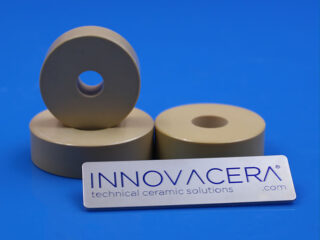
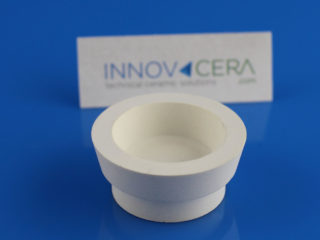
Boron Nitride Crucible for Vacuum Casting Molten Metals

Boron Nitride Crucible

Boron nitride exhibits a hexagonal structure and is sometimes known as white graphite, due to its lubricity, anisotropic properties, heat resistance, and high thermal conductivity. This latter property, combined with low thermal expansion, leads to excellent resistance to thermal shock. All three forms, hot pressed, pyrolytic and hot isostatic pressed, can be used at very high temperatures. However, in an oxidizing atmosphere, the maximum use temperature is 850-900°C. Hot pressed and hot isostatic pressed boron nitride are produced by densification of powder, whereas pyrolytic boron nitride is produced by chemical vapour deposition (CVD), depositing onto graphite at temperatures in excess of 1800°C.

The use temperature of boron nitride ceramic crucible in a vacuum is 1800 degrees, and the use temperature under atmosphere protection is 2100 degrees. The nitrogen or argon atmosphere is the best and has the longest life. The boron nitride crucible is resistant to thermal shock, and will not crack when it is rapidly cooled at 1500 degrees. It will not crack if it is taken out of the furnace at 1000 degrees for 20 minutes and blow and quenched hundreds of times.

Precautions for use:
1. The use temperature in the air should not exceed 1000 degrees, and the surface of boron nitride in contact with oxygen will peel off if it exceeds 1000 degrees.
2. Boron nitride is easy to absorb moisture. The crucible cannot be stored in wet areas and cannot be washed with water. It can be directly wiped off with sandpaper or scrubbed with alcohol.
3. Application direction of boron nitride crucible

Available materials:
1. Ferrous metals: iron, copper, aluminium, nickel, magnesium, bismuth, zinc, etc., alloys FE-CO-NI-SI CO-ZR-NB
2. It does not react with water or acid at room temperature. Boil with water and slowly hydrolyze to generate boric acid and ammonia
3. Rare earth, nitride

Unavailable materials:
1. Antimony trioxide, chromium Heptoxides, molybdenum trioxide, arsenic trioxide, titanium carbide, etc.
2. High-lead glass glaze melts in the air at 800-950 degrees, which will corrode BN, but it will not react under the protection of nitrogen or inert gas.
3. Boron phosphate is corrosive to boron nitride in 1400 degrees nitrogen and will react with hot concentrated or molten alkali and hot chlorine.

INNOVACERA supply all shapes of ceramic crucibles, welcome inquiry.


What do you need to know about ceramic heating elements?

A. Handling and notice of using a ceramic heater

  1. Don’t give the ceramic heater impact like falling down to the ground or striking it hammer forcefully.
  2. Using ceramic heater at rating voltage. High voltage may cause damage to the ceramic heater
  3. A temperature control device should be used on a ceramic heater. And the surface temperature of the ceramic heater should be no more than 800°C since the temperature is closely related to its working life
  4. Don’t use the ceramic heater under the following conditions: quick heat up, a quick cool down, and uneven heat distribution. Because on the above conditions open circuit. racking problems may happen. Please be careful of heat shock besides other situations that are not mentioned here such as incomplete contact with a metal part that will also cause uneven heat distribution.
  5. Don’t put excess strength to Ni-wire and brazing area. If Ni wires were bent many times, power concentration points will become brittle. Crack even breakage may happen. If pulled Ni wires with excess power, the brazing area will be peeled off.

B. Setting notice of ceramic heater.

  1. Turn off the power supply so as not to reach the ignition point of utilizing. Components by using thermal fuse and etc. It has the possibility of making fire caused by rapid rising temperature on the heater due to the factor of breaking the sensor and etc. For the sake of each customer’s responsibility, please make some countermeasures such as turning off the power in case of extreme rapid raising the temperature.
  2. The electric connection should be connected by a terminal or a connector.
    Please don’t connect to bare electric wire directly
  3. Please don’t connect the electric circuit of the ceramic heater to the heater directly.
  4. When installation, please don’t connect or collide the leads.
  5. Please comply with regulations and specifications relating to electricity

C. Treatment of defect problem of our heater

  1. In case of defective is not related to inspection items on our drawing. We will prepare for a limitation sample after discussion with you or review this standard if necessary. And apply the modified standard for further shipment
  2. The case of the detective is related to inspection items on our drawing. We will check the defect samples after the discussion with you. Consequently, if it is our responsibility, we either provide substitute heaters or repair the defect
  3. As for the quality problem, we will analyze the root and inform you of our countermeasure to avoid the next continuous problem.
alumina ceramic heater

Alumina Ceramic Heating Element


Innovacera Live Streaming In SEMICON SEA 2020

Innovacera Live Streaming In SEMICON SEA 2020

SEMICON Southeast Asia is the ideal place to discover the technologies and trends that are driving advances in microelectronics to electronics manufacturing.

Various products from INNOVACERA are widely used in the semiconductor industry. So INNOVACERA has joined the SEMICON Southeast Asia exhibition. Due to the effecting of COVID 19, the SEMICON Southeast Asia exhibition is postponed and it comes with going virtual. INNOVACERA insists on attending the SEMICON Southeast Asia virtual exhibition and our sales engineer May Zhong will have a presentation at Webinar on Aug 21, 14:45-15:05.

If you are interesting, you can register at the website of https://store-sg.semi.org/products/webinar-meet-the-experts-2 in advance and the system will automatically send you a webinar link after you register. Then you can watch our live streaming by joining the webinar through the link. You also can download the “gotowebinar” on a computer or cellphone app. Then register and login in with filling the necessary information.

If you have any questions for our presentation, you can leave messages on Webinar. Then we will reply to you in detail after the presentation. We suggest you can download the “gotowebinar” and leave about 5-10 minutes to fill the necessary information in advance so that you can watch the live streaming on time. You also can add it to your outlook or Google Calendar so that you don’t miss the live streaming.

If you miss the time to visit our live streaming, you also can watch the record file through logging in. If you still have any questions to join in the live streaming, you can email us at sales@innovacera.com.


What is an oxygen sensor?

The oxygen sensor is a key part to control automobile exhaust emissions, reduce automobile pollution to the environment, and improve automobile engine fuel combustion quality through feedback information. It will be of great significance in advocating energy conservation and emission reduction today.

The oxygen sensor consists of an internal ceramic material (called zirconium dioxide) and a porous platinum coating and is protected by a metal casing. Its performance is based on the change in the properties of ceramics at high temperatures, allowing oxygen to diffuse out of the air.

It operates according to the difference in the concentration of oxygen in the exhaust gas and outside air and produces a voltage of 50 mV to 900 mV. The working principle of the oxygen sensor is very simple. In layman’s terms, it is similar to the battery. The zirconium oxide element inside the sensor has the same effect as the electrolyte in the battery. The basic working principle is to use high temperature and platinum as a catalyst under certain conditions, and use the difference in oxygen concentration between the inside and outside of zirconia to generate a potential difference, so the greater the concentration difference, the greater the potential difference. Through the feedback voltage and potential difference to identify the oxygen signal. The main CPU in the car will control the air-fuel ratio according to the voltage signal of the oxygen sensor to adjust the fuel injection pulse width, and play the role of fixed-point fuel injection to achieve no waste and save energy and reduce emissions.


Machinable Glass Ceramic Has Good Machinability

Machinable Glass Ceramic has a continuous use temperature of 800ºC and a peak temperature of 1000ºC. Its coefficient of thermal expansion readily matches most metals and sealing glasses. It processes good machinability and can be lathed, milled, planed, ground, bored, incised, and threaded. It also has the advantages of insulation, pore-free, high/low-temperature resistant, acid and alkali resistant, and thermal impact resistant.

It is widely used for nuclear, microwave high vacuum insulation, the high precision magnetism-free skeleton for aeronautic and astronautic electrical devices, ultra-high voltage insulation for electric motors, and structural parts at strong erosion environments. In terms of machinability, it can take place of aluminium oxide and boron nitride ceramics that are difficult to machine.

machinable glass ceramics


How does the Porous Ceramic Vacuum Work?

Ceramic Vacuum Chuck is a kind of uniform solid or vacuum body produced by using nano-powder. A large number of connected or closed ceramic materials are generated in the material through high-temperature sintering.

The material is Al2O3 or SIC, which is widely used in Semiconductors and electronic devices.

In these applications, it can fix semiconductor wafers, glass substrate materials and other working objects by Vacuum Suction.

Compared with the characteristics of traditional suction cups for the single specification of workpieces, the regional suction function of Ceramic Vacuum suction cups helps to improve the smoothness of the production line and its performance, also avoid the traditional suction cups on the workpiece (especially the Thin Film material) scratches and suction marks.

Porous Ceramic Vacuum Work

In addition to being used to adsorb workpieces, Ceramic Vacuum Chucks can also be used in transmission-type air float modules. Even large pieces of glass substrates and other workpieces can be prevented from directly contacting the platform during transportation and transfer, avoiding.

Attachment of contaminants, stress, static electricity and damage to the glass substrate occurs. Moreover, the porous material can greatly reduce the gas flow, and can achieve the effect of uniform air pressure in the air cushion layer and can maintain a certain floating height.

Porous Ceramic Vacuum


The Introduction of Pyrolytic Boron Nitride Crucible

PBN MBE Crucible

PBN is a particular material of ceramics. It’s sedimentary the process just like ”Snowing” — hexagon-shaped PBN by dropping on graphite material in parallel till to a certain thickness. After cooling, it becomes the PBN ceramic component.  The PBN ceramics are widely used to make VGF crucibles, LEC crucibles, MBE crucibles, Thermal Insulation Board, Synthetic Boat, PBN coated products for making single-crystal from GaAs.

Main Features:

  1. The product is white, non-toxic,non-porous, and easy-making.
  2. The purity is up to 99.99% and its surface is very compact
  3. It has good hermeticity and high-temperature resistance. Its intensity increases with temperature and maximizes at 2200°C.
  4. It has many good properties such as acid-resistance, alkali-resistance, salt-resistance, and reagent-organic-resistance. It is insoluble and non-reactive with most molten-metals, semiconductors, etc.under high temperature.
  5. It has good thermal shock resistance and good conductivity. It has a low coefficient of thermal expansion.
  6. It has high resistance, high dielectric- strength, and low dielectric constant. It has a low magnetic loss tangent.lt has good performance to allow microwave and infrared ray to pass through.
  7. lt has distinct differences among mechanics performance, thermotics performance and electricity performance.

Ceramic Pump Sanitizer Safety Instructions

ceramic metering pump

Here are the Safety instructions of the ceramic metering pump for dosing disinfectant and sanitizer in the filling machine.

  • The ceramic pump can use hot water, soapy water, alcohol, or other cleaning liquid to clean the internal remnants several times through the reciprocating work of the machine until no residue of the material comes out, then rinse with clean water. Or disassemble it for disinfection.
  • When cleaning the internal parts, do not touch the surface of the parts with sharp tools. After cleaning, wait until the parts are dry before installing.
  • Check if the sealing ring of each part is damaged, if any, replace the new sealing ring;
  • Check if the screws in each part are loose, if any, re-lock.
  • Do not flush the motor with cleaning fluid to prevent damage to the components.
  • Try to avoid being in a state of no material for a long time when using it.
  • It is strictly forbidden to enter hard parts or particles other than materials into the pump head assembly.
  • For perfusion of volatile liquids, please use them in a circulating air environment.
  • When the machine is working, it is strictly forbidden that any part of the body or other items are close to the moving parts of the machine. The factory is not responsible for the mechanical damage and personal injury caused by the machine.
  • The equipment must be disconnected from the power supply when replacing components.
  • It is strictly forbidden to use organic flux to clean the machine, such as gasoline, benzene, xylene, banana water, sodium hypochlorite, etc.
  • When the machine is shut down, turn off the power switch, unplug the power cord, and clean up the miscellaneous items.

How to solve the problem of fragile ceramic parts?

Zirconia Ceramic

As we all know, advanced ceramics are special materials with a variety of physical properties. As structural ceramics and functional ceramics apply in machinery, electronics, chemical industry, metallurgy, energy, aerospace, and many other fields.

But ceramics have an obvious disadvantage-fragility. The main reason is that the toughness of most ceramics is low, which leads to an increase in brittleness.

There is a ceramic – zirconia with high toughness. It is formed by thousands of unit cells to form crystals. It then undergoes high-temperature phase transformation to form microcrystalline ceramics so that the ceramics have excellent wear resistance and drop resistance and high-temperature resistance.

ZrO2 ceramic products are white. When the ceramic contains other impurities, the ceramic is grey or yellow. Commonly used molding processes are injection and dry press. They are usually made into crucibles, mobile phone cases, ceramic shafts, abrasive materials, refractory materials, etc.

It is believed that in the near future, the excellent characteristics of zirconia ceramics will be widely used in more fields.


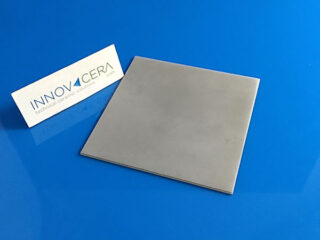
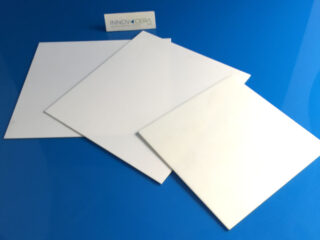
Aluminum Nitride (AlN) Substrates

Aluminum Nitride (AlN) Substrates

The AIN crystal is a covalent bond compound with [AIN4] tetrahedron as the structural unit, and has a wurtzite structure, and belongs to the hexagonal crystal system.

ALN with outstanding insulating properties and extremely high thermal conductivity. In addition, aluminum nitride has the characteristics that it is not attacked by aluminum liquid and other molten metals and gallium arsenide, and particularly has excellent corrosion resistance to molten aluminum liquid.

Aluminum Nitride Substrate Advantages

  • Very high thermal conductivity
  • Non-toxic alternative to BeO
  • Low thermal expansion similar to Si, GaN, and GaAs semiconductors
  • High dielectric strength

Enquiry