technical ceramic solutions

News

Category Archives: News

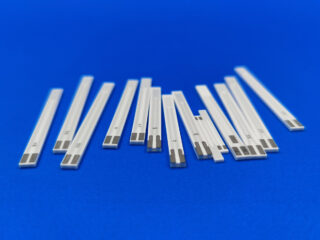
Silicon Nitride Igniter Used for Vegetable Oil Furnace-GL02

Vegetagle Oil Boiler Igniter

A special igniter for vegetable oil furnace was developed successfully in March 2020, which is widely used in vegetable oil boiler, and widely loved by customers.

Short Introduction:
This product uses high-performance silicon nitride ceramics as the substrate, with high-temperature mechanical strength, strong thermal shock resistance, and
resistance to acid and alkali corrosion advantages. It not only has excellent insulation properties but also has good thermal conductivity.

Datasheet of the product:

Bending strength ≥900Mpa RoFracture toughness 6.0-8.0 Mpa.m1/2
volume density 3.20-3.4g/cm3 Volume resistivity at room temperature 1014Ω.cm
Relative dielectric constant 6-7 Thermal conductivity 23-25W/(m-k)
Thermal expansion coefficient 3.1×10⁻⁶/℃ Hardness HRA92-94
Voltage 220V Power 400W
Size 80*17*3.5mm

Performance and Feature:
Good moisture resistance and tightness;
Small size and lightweight;
Excellent thermal performance, fast temperature rise, surface temperature rises to 1100 ℃ in 15 seconds;
Has excellent electrical insulation performance;
High-performance silicon nitride material is used as the base material, which has excellent oxidation resistance, long service life, and on-off up to 100,000 times

Comparative advantages with traditional metal tube heating bodies:
Strong corrosion resistance;
Uniform heating and high heat conversion rate;
Power stability;
Strong bending resistance;
Good sealing;
Low leakage index;
High anti-penetration rate

Application:
Constant temperature vegetable oil boiler, biomass boiler, gas stove boiler, etc.


DPC (Direct Plated Copper) Metallized Ceramic

DPC (Direct Plated Copper) Metallized Ceramic Substrate
Smaller, Thinner Thin Film, Thick Film Design.
Better Heat Dissipation; Longer Lifetime DPC Substrate

Why DPC Metallized Substrate?
DPC is created for better electrical performance and flexibility because of fine line capability and solid copper via fill. DPC is also a cost-effective alternative for the reasons of more flexible manufacturing capability, especially for thinner metallization.

How To Make DPC Substrate?
flow-chart-dpc-metallized-ceramic

 Comparison Of DPC To Other Technologies

Key Attributes

DPC

Thin Film 

Thick Film 

Conductor Electrical Conductivity

Very good. Thick copper conductor.

Poor conductivity due to very thin film thickness.

Good conductivity. Lowered by the presence of the glass phase.

Via Electrical Conductivity

Very good. Vias filled with pure copper.

Very good. Vias filled with pure copper.

Poor. Vias filled with 50% metal and 50% glass or pores.

Feature Resolution

Goood. Depends on Cu thickness.

Very good.

Goood. Determined by screen print capability.

Cost

Low to moderate. Vias and metal deposited in the same process.
Low cost substrate.

High cost. Expensive substrate. Lapp and polish required after via deposition.

Low to moderate. Expensive metal pastes. Low cost substrate and low cost deposition technology.

Thermal Performance

Very good. AIN or alumina substrate and high thermal conductivity metal.

Good. AIN or alumina substrate. Metal layer too thin for heat spreading.

Moderate. Alumina substrate. Conductivity through the metal is poor due to the glass phase.

Suitability for Power Applications

Very suitable. Copper conductors carry high currents.

Not suitable. Thin film layers can not carry high currents.

Suitable. Conductors with a glass phase have moderate conductivity.

Suitability for High Frequency Applications

Suitable. Good conductivity and line resolution

Very suitable. Excellent line resolution.

Not suitable.

Green

Yes

Yes

No. Often contain Pb additives.

Summary
Overall, copper plating performs superior compared to other technologies in terms of its features and applications.

DPC Substrate Features:
Higher circuit density
Outstanding high-frequency characteristics
Excellent thermal management and heat-transfer performance
Outstanding solderability and wire-bonding assembly characteristics
Low tooling costs and quick turnaround of prototypes

Applications of DPC:
HBLED
Substrates for solar concentrator cells
Power semiconductor packaging including automotive motor control
Hybrid and electric automobile power management electronics
Packages for RF
Microwave devices


Innovacera develop standard and customized precision ceramic needle gauges

Innovacera develop standard and customized precision ceramic needle gauges

As we known, the gauge is a vital inspection tool, and most of the company use stainless steel and other metal materials.

Innovacera have developed some standard ceramic needle gauges with size of OD1-12mm and length of 50mm, the interval of diameter size is 0.01mm. We also can make customized size.

There are some advantages of ceramic needle gauge compare to other metal materials: super wear-resistant, corrosion-resistant, non-rusting, non-magnetic, non-conductive, maintenance-free.

Here is some more detail about our ceramic needle gauge:
Inspection instruments: Mitutoyo Laser Measuring Instrument (the equipment deviation is 0.2μm).

Inspection standard:

  • Level-1 Gauge: Temperature 20 ℃ ± 1 ℃, Humidity 50%, upper limit+0.3μm, lower limit-0.2μm; Cylindricity ≤ 0.3μm,Roundness ≤ 1μm;
  • Level-0 Gauge: Temperature 20 ℃ ± 1 ℃, Humidity 50%, upper limit+0.1μm, lower limit-0.1μm; Cylindricity ≤ 0.1μm,Roundness ≤ 0.6μm;
  • Level-0 gauge accuracy is ±0.0005mm.

If you need any standard or customized precision cerotic needle gauges, welcome to contact us.


Porous ceramic chuck table used in semiconductor equipment

Porous ceramic chuck table

Porous ceramic chuck table is a so important part in semiconductor equipment such as silicon wafer processing.

Porous Ceramic Vacuum Chucks are widely used as important components of equipment in silicon wafer, semiconductor compound wafer, piezoelectric ceramic, glass, LED, semiconductor package component substrate, optical component thinning, cutting and so on.

The advantages include the following:

  • Strong permeability: Uniform air permeability and water permeability to ensure the uniform stress and firm adsorption of the silicon wafer, so that it does not slip during the grinding process.
  • Compact and uniform structure: Due to the dense and uniform microporous ceramic, the chuck table is not easy to adsorb silicon powder abrasives and is easy to clean.
  • High strength: No deformation during grinding, to ensure that the silicon wafer is uniformly stressed at all points during grinding, and is not easy to edge breakage and debris.
  • Long service life: The surface shape is good, the dressing cycle is long and the dressing amount is small, so it has a long service life.
  • Easy to repair: There are no cracks, chips, threshing during machining.

Global DBC Ceramic Substrate Market Is Holding Great Promise

DBC (Direct Bonded Copper) substrates are composed of a ceramic insulator, Al2O3 or AlN onto which pure copper metal is attached by a high-temperature eutectic melting process and thus tightly and firmly joined to the ceramic.

DBC Ceramic Substrate Key Features:

Ceramic metallized: Ti/W, gold(Au), silver(Ag),Copper(Cu),nickel(Ni)¡Kothers & produce final circuitDBC Ceramic Substrates
Coating: 0.075um to 5mil

Ceramic Metallized substrate:
Al2O3 substrate metallized
AlN substrate metallized
Silicon wafer metallized


LED heat-dissipation ceramic substrate:
LED Al2O3 thin film substrate
LED Al2O3 thick film substrate
LED AlN thin film heat-dissipation substrate
Flip-chip substrate
The integration of the thin film, thick film, electrode plating and electroless plating processes

Application:
1. High Power LED ceramic substrate
2. Microwave (Wireless Communication & Radar)
3. Semiconductor Process Equipment
4. Solar Cell
5. Hybrid Electric Vehicles
6. Flip-chip/eutectic substrate
7. Sensor ceramic substrate

In future, the DBC ceramic substrates market will develop rapidly, driven by the demand from IGBT, automobile, CPV, aerospace and communication. The electric vehicles market will drive the DBC ceramic substrates to increase in the next ten years.


How to connect ceramic heater without lead wire to power supply?

Ceramic Heater Without Lead Wire and With Lead Wire

Our PTC ceramic heater has two kinds: one is with lead wire, another is without lead wire.
But how to connect the ceramic heater without lead wire to the power supply?
Please let me explain it to you.
As you can see that there is end nickel plating on the ceramic heater which can connect to the power supply using the way of Contact shrapnel:
Just like our battery remote control, there are positive and negative electrodes, and we connect them with a metal spring plate.
When the battery goes in, the spring plate deforms, we connect it.

Attached is the video for your reference.


Ceramic guide rollers-high hardness better than metal

Ceramic guide rollers

Guide rollers are used in the process of manufacturing metal wire. Since the wire travels at high speeds, high levels of tension act on the guide rollers and wear down their surface. As a result, there was a need to replace components frequently. Therefore, this requires that guide rollers have a high degree of hardness as well as have a smooth surface.

Metal components had conventionally been used in guide rollers. However, since their surface tends to wear through contact with the metal wire, surface roughness would worsen. This surface roughness on the guide rollers would then scratch the metal wire when coming in contact, thus affecting product quality.

By switching to ceramics, which are harder than metals, there was less occurrence of scratching as a result of guide roller surface wear. This resulted in less scratching from contact between the metal wire and guide rollers, contributing to higher quality production.

Furthermore, with improved wear resistance, rollers required less frequent replacement, alleviating maintenance work.

Now the most commonly used material is zirconia, ZTA, 99% alumina.


Metallization of alumina and application

Alumina Metallized Ceramic Insulator Parts

With the development of modern technology, more and more new materials used in various fields. Technical ceramics are one of them, and the most popular is alumina(Al2O3).

However, since ceramic is an insulating material, it cannot be directly connected with other components. We wanted to make it even more useful, so ceramic metallization was born out of operations.

Ceramic metallization is to firmly adhere to a layer of metal film on the ceramic surface. The main role is to realize the welding between ceramic and metal. A more advanced application is to form a circuit on the surface of the ceramic, which can not only be welded but also be used as a wire to transmit current.

Nowadays, there are many methods used to manufacture metallization, including molybdenum manganese (Mo-Mn), Gold plating, Copper plating, LAP, etc.

Innovacera metallization of alumina main material is 95% alumina and 99% alumina. We will perform ceramic surface treatment before metallization to ensure the quality of metallized products.

Therefore, there will be advantages such as precision scale, small warpage, strong bonding between metal and ceramic, dense joints between metal and ceramic, and excellent heat dissipation.

So, Alumina ceramics widely used in LED heat dissipation substrates, ceramic packages, electronic circuit substrates, and electronic and electrical components.


Application of Aluminium Nitride Ceramic

Aluminium nitride has a high heat transfer ability so that aluminium nitride is widely used in microelectronics. Unlike beryllium oxide, aluminium nitride is non-toxic. Aluminium nitride is treated with metal and can replace alumina and beryllium oxide for a large number of electronic instruments.

(1) Refractory materials. Aluminium nitride is not only resistant to high temperature, corrosion, alloys and metals such as aluminium and iron, but also non-wetting with silver, copper, aluminium, lead, etc., and can be used to make refractory materials or coatings for crucibles as surface protection material. It can also be made into structural materials such as casting moulds and crucibles.

(2) Electronic substrate material. Aluminium nitride ceramics are widely used in multi-chip modules in military fields, microwave power amplifiers, and laser diode carriers, LED heat sink substrates and high-temperature semiconductor packages in civilian fields. Aluminium nitride substrates are also widely used in electric and gas hybrid automobiles — aluminium nitride ceramic carrier substrate for power module circuits. The use of aluminium nitride as the LED packaging material has the following advantages: Good heat resistance and thermal conductivity, which can increase the service life of the material; Can make a thinner packaging material.


Machinable Glass Ceramic Insulating Bar for Medical Applications

Machinable Glass Ceramic Insulating Bar for Medical Applications

machinable glass ceramic insulating bar

machinable glass ceramic insulating bar

This ceramic bar is used for processing of insulators on Medical devices.

Machinable Glass Ceramic has a continuous use temperature of 800℃ and a peak temperature of 1000℃. Its coefficient of thermal expansion readily matches most metals and sealing glasses. It processes good machinability and can be lathed, milled, planed, ground, bored, incised and threaded. It also has the advantages of insulation, pore-free, high/low-temperature resistant, acid and alkali resistant and thermal impact resistant.

It is widely used for nuclear, microwave high vacuum insulation, high precision magnetism-free skeleton for aeronautic and astronautic electrical devices, ultra-high voltage insulation for electric motors and structural parts at strong erosion environments. In terms of machinability, it can take place of aluminium oxide and boron nitride ceramics that are difficult to machine.

Stock size of rods
φ10*100mm; φ15*100mm; φ20*150mm; φ25*150mm; φ30*150mm; φ35*150mm; φ40*150mm; φ45*150mm; φ 100*100mm ; φ50*150mm; φ55*150mm; φ60*100mm; φ65*100mm; φ70*100mm; φ75*100mm; φ80*100mm; φ85*100mm; φ90*100mm; φ105*100mm;φ110*100mm
φ4 ×300 mm; φ6 ×300 mm; φ8×300 mm; φ10×300 mm; φ12×300 mm; φ16 ×300 mm; φ21 ×300 mm
φ26×300 mm; φ30 ×300 mm; φ8×300 mm; φ50×300 mm

machinable glass ceramic components show

machinable glass ceramic components show

Customized design will be available for INNOVACERA


Enquiry