technical ceramic solutions

News

Category Archives: News

Technical Ceramic Components Work In Semiconductor Industry

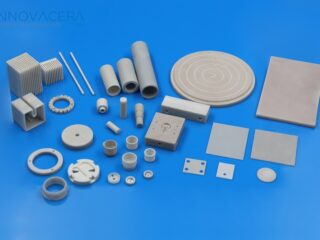
Technical Ceramic Components are integral to semiconductor manufacturing equipment, technical ceramic components are high in purity with low levels of trace metals, this means they can constitute either the process chamber material or interior process surfaces for CVD, PVD, plasma etching, and ion implanting where their strong dielectric properties are highly beneficial, so it is widely used in the semiconductor industry.

PBN MBE CrucibleThe semiconductor industry uses advanced technical ceramics including alumina ceramic (AL2O3), aluminum nitride (ALN), Porous Ceramic, Boron Nitride (BN), pyrolytic boron nitride (PBN), and silicon carbide (SiC). PBN has primarily been used for crucibles in metal oxide (MOCVD) deposition tools, the mainly single crystal growth methods are LEC and VGF, so PBN LEC and VGF crucibles are required. PBN molecular beam epitaxy (MBE) crucibles are one of the most important epitaxy growth processes for group III-V and group II-VI semiconductor crystals in the world today. PBN crucible is the best container for evaporating elements and synthetic materials in this process. The PBN ring around the evaporation crucible is used in OLED equipment.

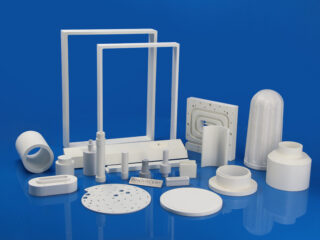
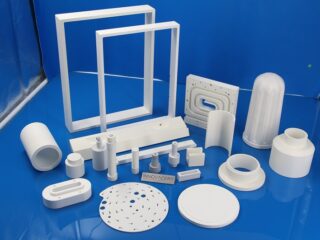
More ceramic parts used for the semiconductor industry are as below:

Boron nitride ceramic insulator part used for PVD and MOCVD equipment Porous Ceramic Vacuum Chuck Metallized Ceramic Disc
Boron nitride ceramic insulator part used for PVD and MOCVD equipment. Porous ceramics are widely used for Vacuum chucks. Metallized ceramic parts for IC package.

ceramic wafer robot’s arm ceramic end effectorsAlumina ceramic and aluminum nitride are typically used for electrostatic chucks in chamber interiors. Innovacera manufacture ceramic wafer (generally called robot’s hand) which is used for end effectors, ceramic end effectors have good stiffness and high strength, so the robot arm settles to its final position faster. End effectors constitute the end of the robot arm which handles and moves the semiconductor wafer between positions.

The ceramic material is chosen based on the deposition chemistry to which it will be exposed. Such as if plasma is used, a minimum of 99.5% alumina must be used. Plasma corrosion resistance is the main characteristic of components in semiconductor manufacturing equipment.

Aluminum nitride ceramicsAluminum nitride (AlN) is a covalent bond compound with a hexagonal wurtzite structure with lattice parameters a=3.114 and c=4.986. The color usually is gray and is a typical III-V wide-bandgap semiconductor material.

Aluminum nitride ceramics have the characteristics of high strength, high volume resistivity, high insulation withstand voltage, thermal expansion coefficient, and good matching with silicon. They are very suitable for semiconductor substrates, ceramic electronic substrates, and structural packaging materials. The potential in the electronics industry is huge.

Innovacera is an advanced ceramic components manufacturer established in 2012, has rich experience in the ceramic industry, strictly controls the product quality and inspection by excellent teams. We offer custom solutions beyond our existing products. We warmly welcome customers to establish cooperation and create a bright future with us together.

For more information, please contact us as below:

Xiamen Innovacera Advanced Materials Co., Ltd
A506-507, No.7 Yu’nan Fourth Road, Huli District, Xiamen, Fujian, China
Tel: 86-592-5589730
Email: sales@innovacera.com
Website: www.innovacera.com

Boron Nitride Ceramic Components for High-Temperature Furnace Applications

Boron Nitride

Boron nitride, also known as white graphite, has a structure similar to that of graphite. It has good electrical insulation, thermal conductivity, excellent thermal shock resistance, and Chemical stability. Boron nitride ceramics are processed by hot-pressing and sintering boron nitride powder into product blocks according to the customer’s required size specifications.

The design of high-temperature furnaces operating at temperatures significantly higher than 1500°C incorporates heating elements manufactured from carbon, tungsten. As a rule, these elements are electrically insulated from the furnace sides using high-temperature oxide ceramics.

In this field, we can offer precision machined components such as tubes, washers, sleeves, insulators, insulating plates, spools, flanges, and other parts subjected to high thermal stresses.


Why use Microporous Ceramic for Vacuum Chucks

Microporous Ceramic Vacuum Chuck

Vacuum chucks are used in the thinning, dicing, cleaning, handling, and other processes of semiconductor electronic chips, like wafers. Why choose microporous ceramic vacuum chucks?

1. During the polishing and cleaning process of wafers, polishing liquid and water mist enter the working table, causing corrosion. And the microporous ceramic vacuum chucks resist corrosion.

2. The microporous ceramic vacuum chuck has no environmental pollution such as light, heat, and electromagnetic, unlike the rubber or other materials vacuum chuck. And the rubber or other materials vacuum chuck will be in direct contact with the surface of the item, so it is very easy to wear.

Therefore, the porous ceramic has high temperature resistance and chemical corrosion resistance, light structure, and electrical insulation. So it is the best choice for vacuum chuck.

3. With its special porous structure, the microporous ceramic has very small holes and can be machined to very precise flatness. Combined with the special air channel design, when a certain negative pressure is given, the wafer can be smoothly and stably adsorbed on the vacuum chuck, so as to avoid wafers that will cause scratches and dents on the surface.
Through the coordination of the focus point and suction force of the vacuum suction cup, wafers of different sizes can be adsorbed on the same ceramic surface.

4. The microporous ceramic vacuum chuck can be reused after regrinding, thereby improving the utilization rate of materials.

Inspection Video:


Benefits of Advanced Ceramic Thick Film Metallization

Metallized Ceramic

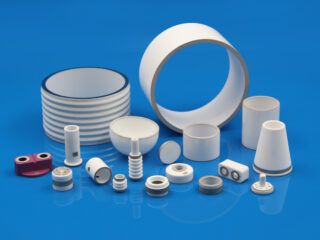
Ceramic metallization is a process in which a layer of metal is deposited onto the ceramic surface to provide a wettable surface for subsequent brazing.

INNOVACERA metallizes precision ceramic components for use in power grid tubes, vacuum interrupters, and similar applications. Our metallized parts are used in critical assemblies brazed by our in-house team or by other brazing suppliers and OEMs. Our metallization creates a strong and robust bond to many different ceramic bodies and has nearly universal applicability for ceramic to metal brazing.

Benefits:
♦ Strong, robust bond
♦ Minimal substrate deformation
♦ Universal applicability for ceramic metal joining
♦ High processing speeds
♦ Uniform coating, thickness, and density


Innovacera Ceramic Rapid Prototyping Services For OEM Ceramic Parts

Silicon Nitride (Si3N4) Ceramic

Rapid prototyping of OEM ceramic parts helps the wait time reduced and economical shorter runs. For some researched & developed projects, the resultant parts may reveal some design changes that would otherwise mean adjusting or even scrapping tooling had it been required, rapid prototyping can save developing time and project cost. Rapid prototyping ceramic components also provide a means to produce a low quantity of OEM parts at a reasonable cost and produce time, working directly from your CAD file.

Innovacera provides ceramics rapid prototyping service, this allows you to validate your new designs whether are workable or not before committing to expensive new tooling.

We can process your ceramic part through your CAD or SolidWorks design files by our precision CNC machining center to cut your custom components from a blank made from our specially developed machinable alumina ceramic, zirconia ceramic, silicon nitride, aluminum nitride, boron nitride, and machinable glass-ceramic materials. Blanks are usually available from Innovacera stock so that items can be produced quickly; this also allows a fast turn-around of design changes where product optimization is carried out.

Innovacera also provides one-stop service from prototype to low volume production. Innovacera factories have hot press dring, CIP, dress press, ceramic injection molding, CNC machining, and other processes to support low volume production.

The application of ceramic rapid prototyping was motivated by the advances in engineering ceramics and traditional ceramics where methods of creating complex shapes are limited. Ceramics have many outstanding physical and chemical properties and attract lots of researchers’ attention to find new industrial applications for this kind of material such as components used in semiconductor, laser, vacuum, analysis, thin film deposition equipment parts, sensor part and electrical insulator part and so on.


Pyrolytic Boron Nitride (PBN) Ring for OLED and MBE Effusion Cell

PBN Filament Ring Pyrolytic Boron Nitride (PBN)

Pyrolytic Boron Nitride (PBN) is a kind of advanced ceramic, that can be produced with 99.99% purity in high density. It is made by ammonia and Boron halide through Chemical Vapor deposition(CVD) process in high temperature and high vacuum conditions: NH3 + BX3 = BN + 3HX, it can be produced as PBN plates, and also can be produced as PBN final products directly like a crucible, boat, coating, etc.

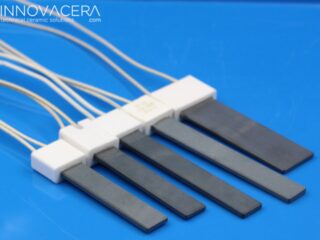
The heating element is constructed from alloy filament supported by a PBN ring which provides excellent temperature uniformity within the crucible, high heating efficiency even at the crucible lip. Crucibles are easily replaced.


Boron Nitride Ceramic Crucibles

BN Crucible Hearth Liner

Outstanding features of Boron Nitride

  • Good thermal expansion coefficient and excellent thermal shock resistance.
    The thermal conductivity is 10 times that of quartz, which can reduce the risk of cracking due to rapid temperature changes. So there is no problem even after several cycles of 20~1200°C.
  • Boron nitride does not react with acids, alkalis, glass, and most metals, and its mechanical strength is low, only slightly higher than graphite, but there is no load softening phenomenon at high temperatures. It can be processed by general metal processing machines. It is suitable for melting and evaporating metal crucibles, utensils, liquid metal conveying pipes, and molds for casting steel.

Classification of boron nitride crucible

  • PBN crucible
    The PBN crucible does not need to go through the traditional hot pressing sintering process and does not need to add any sintering agent, it has a high purity (above 99.99%), the operating temperature under vacuum is as high as 1800 degrees, and the operating temperature under atmosphere protection can reach up to 2100 degrees (Usually nitrogen or argon), it is mostly used in evaporation/molecular beam epitaxy (MBE)/GaAs crystal growth.
  • Sintered BN crucible
    The sintered BN crucible is made of hexagonal boron nitride and sintering aids (Y2O3, etc.) as raw materials, and is made by high-temperature sintering after molding.
    It has good heat resistance, thermal stability, thermal conductivity, and high-temperature dielectric strength. So it can resist most of the erosion of the molten metal.
    The sintered BN crucible contains a sintering aid (1~6wt%), the purity is not as high as that of the PBN crucible. It is suitable for making large-size crucibles. The maximum temperature used in inert gases such as argon or nitrogen is 2800°C; the stability in oxygen is poor and can only be used below 900°C.

Application of boron nitride crucible

  • It is very suitable as a material used under strict environmental conditions such as semiconductor manufacturing processes. Group V semiconductors: gallium arsenide, gallium phosphide, and indium phosphide.
  • It can also be used to make insulating materials or glass fixtures for various heaters, heating pipe sleeves, and high temperature and high frequency, High-pressure heat dissipation material.

AIN Wafer – One Of The Most Popular Ceramic Substrate

Aluminum Nitride Ceramic Substrate

INNOVACERA provides AlN ceramic substrate. AlN substrate is one of the most popular ceramic substrates which has excellent heat resistance, high mechanical strength, abrasion resistance, and small dielectric loss. The surface of the AlN substrate is quite smooth and has low porosity. Aluminum Nitride has higher thermal conductivity, compared to alumina substrate, It is about 7 to 8 times high. AlN substrate is an excellent electronic package material.

INNOVACERA provides AlN substrate for a wide range of applications, including thin film and thick film microelectronic, high power and high-frequency circuit RF/microwave components and capacitor or resistor, contact us for more ceramic wafer product information.

AlN Wafer Properties:

Chemical formula AlN
Color Gray
Density 3.3 g/cm3
Thermal conductivity 160 ~ 190 W/m.K
Thermal Expansion (x10 -6/°C) 2-3.5
Dielectric strength ≥17KV/MM
Dielectric Constant (at 1MHZ) 8-10
Loss Tangent (x10 -4 @1MHZ) 2.0
Volume Resistivity ≥10^14 ohm-cm

AlN Wafer Properties:

Diameter Ø 16 / Ø 20 / Ø 30 / Ø40 / Ø 50 /Ø 60 / Ø 75 / Ø 80
Square size 2″x 2″ / 3″ x 3″ / 4″ x 4″ / 4.5″ x 4.5″
Thickness 0.385 mm / 0.5 mm /0.635mm/ 1 mm
Surface As fired
  one side polished / two sides polished
Roughness Ra 0.3-0.5 um

Ceramic Boron Nitride Setters For Sintering Nitride Ceramics

BN setters

Due to Boron Nitride’s high purity, non-adhesive and long working life, it’s a good choice used for sintering Aluminum Nitride and Silicon Nitride substrates. And it won’t make pollution for the sintering process.

Hexagonal Boron Nitride has a low expansion coefficient and high thermal conductivity, so it has excellent thermal shock resistance, and it will not be damaged even after hundreds of times of cycle use at 2000°C. The expansion coefficient of BN is equivalent to that of quartz, but the thermal conductivity is 10 times that of quartz.

Features of Boron Nitride:

  • High purity with 99.7%
  • Quality stable in mass production
  • No deformation in high temperature
  • Max working temperature is over 2100°C
  • Resist high heat shock

All the features make Boron Nitride a very good material for the sintering field. Our Boron Nitride is an alternative for Denka NB-1000.

The advantages for choosing us:

  • Competitive price
  • Short delivery time (20-35 days)
  • Stable quality
  • Do adjustments very quickly due to customers’ feedback on quality.
  • The max dimension we can make: 500×500 mm

What Are The Advantages of MgO-ZrO2 Ceramic?

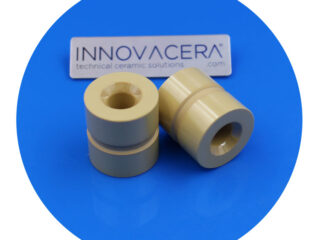
MgO ring

Magnesium oxide Zirconia ceramics have high oxygen ion conductivity, high strength and toughness, and good thermal shock resistance. It is a promising high-temperature functional and structural ceramic material. Magnesium oxide is used as a stabilizer. The cubic phase material is packed into tiny tetragonal deposits and thus has a very high transformation toughness. The fracture toughness of magnesium oxide Zirconia is high.

It has excellent mechanical properties, including high strength, fracture toughness, wear resistance, low thermal conductivity, and good thermal shock resistance. Because of its resistance to wear and corrosion, it is mainly used in valves, pumps, and gaskets, and is also used in chemical processing and petrochemical industries.

MgO-ZrO2 ceramic main features:

  • Excellent fracture toughness
  • Good wear resistance
  • Good corrosion resistance
  • Good thermal shock

MgO-ZrO2 ceramic main application:

  • Pump parts
  • Valve components
  • Bearings

Enquiry